"Let unity, the greatest good of all goods, be your preoccupation." - St. Ignatius of Antioch (Letter to St. Polycarp)

Tuesday, June 1, 2010

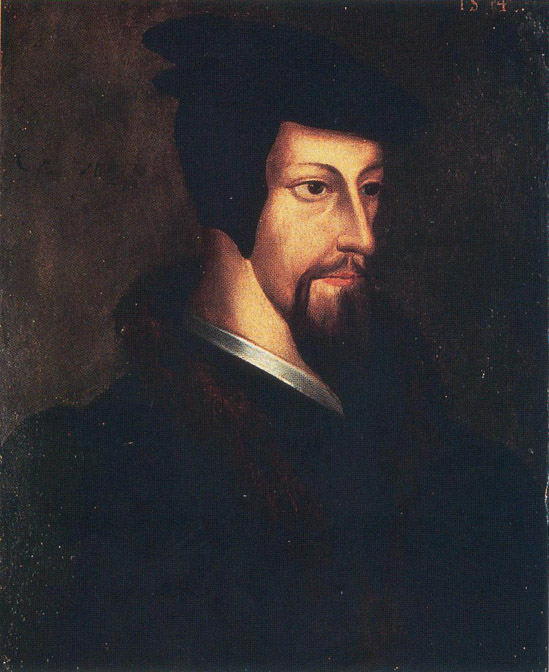
How John Calvin Made me a Catholic


John Calvin
Dr. David Anders received his Ph.D. from the University of Iowa in 2002, in Reformation history and historical theology. He was received into the Catholic Church in 2003. He has recently written an article titled "How John Calvin Made me a Catholic." He will be on EWTN Live on June 23rd, 7:00 pm Central (8 EST), and may be discussing some of the material from this article.

(Continue reading)


Saturday, May 22, 2010

Pentecost, Babel, and the Ecumenical Imperative


"But as the old Confusion of tongues was laudable, when men who were of one language in wickedness and impiety, even as some now venture to be, were building the Tower; (Genesis 11:7) for by the confusion of their language the unity of their intention was broken up, and their undertaking destroyed; so much more worthy of praise is the present miraculous one. For being poured from One Spirit upon many men, it brings them again into harmony." (St. Gregory of Nazianzen, Oration 41)

(Continue reading)

Friday, May 14, 2010

Holy Orders and the Sacrificial Priesthood


Tim Troutman has just published an article at Called To Communion. The article is titled "Holy Orders and the Sacrificial Priesthood." He writes:

At the heart of the separation of Catholics and Protestants lies a disagreement about the ecclesial hierarchy. Who are the rightful shepherds of Christ’s flock? This article will examine the Catholic Church’s doctrine of the sacrificial priesthood, and in doing so, will lay the foundation for our subsequent discussion on the critical issue of apostolic succession. We will argue for the following four claims. The hierarchical difference between the clergy and the laity was ordained by God and is supported by the Biblical data. The distinction between presbyters and bishops existed from apostolic times and was intended by Christ. Christian ministers are ordained into a visible priesthood that is distinct from the general priesthood of all believers. Finally, Holy Orders is a sacrament.

(continue reading)

Sunday, May 2, 2010

An opportunity to study orthodox Catholic theology


At Called to Communion I posted a link to two lectures recently given by Professor Lawrence Feingold on the Councils of Ephesus and Chalcedon. As usual, these lectures are outstanding both historically and theologically. In my opinion, Professor Feingold is one of the premier Catholic theologians in the United States. (See the latest issue of The Thomist for responses to his book The Natural Desire to See God According to St. Thomas Aquinas and His Interpreters.) And yet his lectures are clear and accessible even to those with very little theological training. This, in my opinion, is an additional mark of a good theologian.

If you are looking for an opportunity to deepen your understanding of Catholic theology or become qualified to take on some pedagogical role of service in your diocese or parish, and would like to study under Professor Feingold and other well qualified and orthodox Catholic theologians, consider taking classes in the Institute for Pastoral Theology (IPT) through Ave Maria University. The IPT is currently accepting applications for the Master of Theological Studies degree program for classes beginning in August 2010. Classes meet one weekend per month in various locations around the US, ten months each year. Deadline for applications is June 1, 2010. For further information, visit their web site at www.ipt.avemaria.edu.

Tuesday, April 27, 2010

Hadley Arkes becomes Catholic


Hadley Arkes and Michael Novak
In October of 2008 I sat in a large room in Boston College and listened to probably the wittiest-yet-substantive lecture I have ever heard. The lecturer was Hadley Arkes, the Edward Ney Professor of Jurisprudence and American Institutions at Amherst College, prolific author and frequent contributor to First Things. This past Saturday in Washington D.C., Hadley, who is Jewish, was received into the Catholic Church. Read more here and here.

UPDATE: Hadley tells his story here.


Photo courtesy of Frank Beckwith.

Saturday, April 24, 2010

Thursday, April 22, 2010

Five years ago today


Five years ago today, I decided to seek full communion with the Catholic Church. This was three days after Pope Benedict's election as the 265th successor of St. Peter, and two days after Pope Benedict, in his first message as Pope, said the following:

Nourished and sustained by the Eucharist, Catholics cannot but feel encouraged to strive for the full unity for which Christ expressed so ardent a hope in the Upper Room. The Successor of Peter knows that he must make himself especially responsible for his Divine Master's supreme aspiration. Indeed, he is entrusted with the task of strengthening his brethren (cf. Lk 22: 32).

With full awareness, therefore, at the beginning of his ministry in the Church of Rome which Peter bathed in his blood, Peter's current Successor takes on as his primary task the duty to work tirelessly to rebuild the full and visible unity of all Christ's followers. This is his ambition, his impelling duty. He is aware that good intentions do not suffice for this. Concrete gestures that enter hearts and stir consciences are essential, inspiring in everyone that inner conversion that is the prerequisite for all ecumenical progress.

Theological dialogue is necessary; the investigation of the historical reasons for the decisions made in the past is also indispensable. But what is most urgently needed is that "purification of memory", so often recalled by John Paul II, which alone can dispose souls to accept the full truth of Christ. Each one of us must come before him, the supreme Judge of every living person, and render an account to him of all we have done or have failed to do to further the great good of the full and visible unity of all his disciples.

The current Successor of Peter is allowing himself to be called in the first person by this requirement and is prepared to do everything in his power to promote the fundamental cause of ecumenism. Following the example of his Predecessors, he is fully determined to encourage every initiative that seems appropriate for promoting contacts and understanding with the representatives of the different Churches and Ecclesial Communities. Indeed, on this occasion he sends them his most cordial greeting in Christ, the one Lord of us all.

Pray to God that many young men and women would rise to this call, and join with Pope Benedict in rebuilding the full and visible unity of all Christ's followers, through the charitable pursuit of truth and peace in Christ. May this be our ambition, and our impelling duty. May the heart of the Shepherd be the heart of Christ's sheep. As Pope Benedict said, each of us will come before Christ to give an account to Him of all that we have done or have failed to do to further the great good of the full and visible unity of all His disciples. May our labor of love now be such that on that Day we are not ashamed.

Video H/T: dans la tradition

Tuesday, April 6, 2010

Michael Spencer (1956-2010) R.I.P.


Michael Spencer
I learned last night that Michael Spencer (aka IMonk) has passed from this life into the next. He began suffering symptoms less than a month after our interview in November, and was diagnosed with cancer right before Christmas.

I didn't know Michael well. Over the past two years, he occasionally commended or criticized things I wrote, and from time to time I did the same to some of the things he wrote. But, it was clear to both of us, I think, that under the disagreements, there always remained a mutual respect, and a mutual recognition of a shared faith in Christ. My experience with him through the interview only confirmed that. He was a gracious gentleman to me. From my point of view, Michael was a kind of visionary. He saw the problems in Evangelicalism that few inside seem to see, and he had the courage to look for solutions outside of what he called the "evangelical wilderness." What I said about him at the time of the interview is this:

Especially over the last year or so Michael has been doing things that no other prominent Evangelicals (that I know of) are doing. It might be called an honest and transparent self-examination of Evangelicalism, seeking to determine its strengths and its weaknesses, its identity and its future. He's not doing it to be critical, but to save it. The fascinating part of this endeavor, from my point of view, is that in seeking to understand and preserve Evangelicalism, Michael, in a sense, has flung open the doors to receive insight from other Christian traditions. And that has begun an ecumenical conversation. Such conversations can easily devolve into ugliness, especially on the internet. But Michael runs a tight ship, and so has fostered a safe context in which these discussions can take place. The result is often that Baptists and Lutherans and Calvinists and Catholics and Pentecostals and Orthodox and Anglicans are all talking to each other in a friendly, respectful way, about their theology and practice. In this respect, what Michael is doing ecumenically is pioneering. So I'm grateful for his invitation to contribute to the discussion.

Michael, thank you for all you did. You will be missed.

Requiem aeternam dona ei Domine; et lux perpetua luceat ei. Requiescat in pace. In nomine Patris et fillii et Spiritus Sancti. Amen.

Saturday, April 3, 2010

Tom Brown comes home

Regular readers of this blog know my friend Tom Brown (who also goes by 'Thos'), who has commented here for several years, and runs his own blog titled Ecumenicity, and is an editor at Called To Communion.

Tom and his family are being received into full communion with the Catholic Church tonight at the Easter Vigil. The Archdiocese of Seattle has the story.

To welcome and congratulate Tom and his wife, go here and leave a note in the combox.

Friday, March 5, 2010

Telegraph: 100 US Anglican parishes to enter the Catholic Church


Telegraph: 100 US Anglican parishes to enter the Catholic Church

Each of the bishops of the Anglican Church in America have made this request to the Holy See, but apparently each individual parish must decide whether to accept it.