"Let unity, the greatest good of all goods, be your preoccupation." - St. Ignatius of Antioch (Letter to St. Polycarp)
Showing posts with label Prayer for peace and unity. Show all posts

Wednesday, September 23, 2009

"I unite you to My Passion"


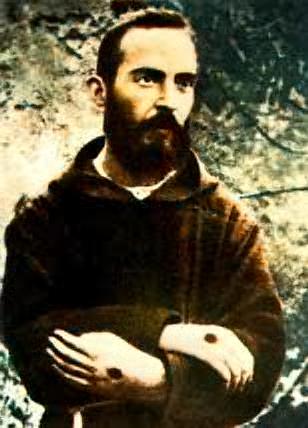
St. Padre Pio

I heard this voice: ‘I unite you to my Passion’. And immediately, the vision having disappeared, I came to and I saw these signs from which blood was flowing.  I did not have them before.” (Source)

Union with Christ is for us now a union with His Passion. "We are fellow heirs with Christ, if indeed we suffer with Him in order that we may also be glorified with Him." (Rom 8:17) Hence it follows that the union of Christ's followers, one with another, is perfected through suffering, even our suffering, joined to His. Stigmata are a sign to all Christians of the continuing presence of God with His Church, and of our call to lay aside our pride, and take up our cross. Our crosses and wounds are usually not extraordinary as were the stigmata of St. Padre Pio. But by dying to our own primacy, even in little ways, we find our true place in His Mystical Body under His Headship, and our true home in that eternal Kingdom. Only in so dying is our life given out to others, and Christ's through ours. Bearing the wounds of Christ is a great honor, as Peter recognized himself not worthy to be crucified upright as was the Lord. There is no greater humiliation in the eyes of men than death upon the cross of Christ, but no greater glory in the eternal life that awaits us, for those who share Christ's cross with Him. The dying one, through suffering, sees the end, and the End. For that reason he is quick to seek peace and make peace, because he sees himself with another on the way with him, together approaching the Judge. (Matt 5:25) This is now our opportunity as Christ's followers, to seek peace with one another, in charity and patience, yet with the urgency of those who know they are dying, and so have little time to give what they can. Christ came preaching peace to those who were far away and to those who were near. (Eph 2:17) What will our generation have suffered, and what we will have sacrificed, to bring the peace of reconciliation and reunion to those with whom we are on the way? What Christ said to St. Padre Pio, He says to us as His people: "I unite you to My Passion." While we have the opportunity, may we bear His cross for the joy that is set before us, despising the shame, to bring to others the peace He brought to the whole world, and especially to the household of faith.

St. Padre Pio, pray for us, that with God's help we may heal those wounds that separate Christ's followers, bearing them in ourselves instead.

Wednesday, November 12, 2008

One, Holy, Catholic and Apostolic Church


Dr. Lawrence Feingold
Dr. Lawrence Feingold, a professor of theology in the Institute for Pastoral Theology of Ave Maria University, converted to Catholicism in 1989. This Fall he has been giving weekly lectures for the Association of Hebrew Catholics, and these lectures are outstanding. You can download the mp3 files of his talks on the four marks of the Church here. I highly recommend them. In my opinion, Professor Feingold is one of the greatest living theologians in the world. He is a living exemplar of what St. Paul says in Romans 11:12,15 concerning the Jews,

Now if their transgression be riches for the world and their failure be riches for the Gentiles, how much more will their fulfillment be! ... For if their rejection [of Christ] be the reconciliation of the world, what will their acceptance [of Christ] be but life from the dead?

Listen to his lectures, and it will be clear that I am not exaggerating.

Today is a memorable day for my family. Today would be the sixteenth birthday of our son, Joshua. Reflecting on his death makes us more eager for heaven. As of this post, I'll be taking a lengthy break from blogging, to focus on my other responsibilities. The comments are all closed. I will not, however, cease to pray daily for the full and visible unity of all Christians, that we would share all three bonds of unity. This is the heart of Jesus, as revealed in His prayer in St. John 17. I hope that you too will include this in your daily prayers.

Lord Jesus, please draw all those who love you into the fullness of the unity Your Sacred Heart desires that we have with one another, and with you. May we be truly one, in Love and Truth, as you and the Father are one, that the world may see in us the Love and Truth of the Holy Trinity. In the name of the Father, and of the Son, and of the Holy Spirit. Amen.

Monday, November 10, 2008

This is not unity among Christians

Here and here.

"that they may all be one; even as Thou, Father, art in Me, and I in Thee, that they also may be in Us; that the world may believe that Thou didst send Me. And the glory which Thou hast given Me I have given to them; that they may be one, just as We are one; I in them, and Thou in Me, that they may be perfected in unity, that the world may know that Thou didst send Me, and didst love them, even as Thou dist love Me." (St. John 17:21-23)

Lord Jesus, have mercy. Forgive us.

Friday, November 7, 2008

Da pacem Domine


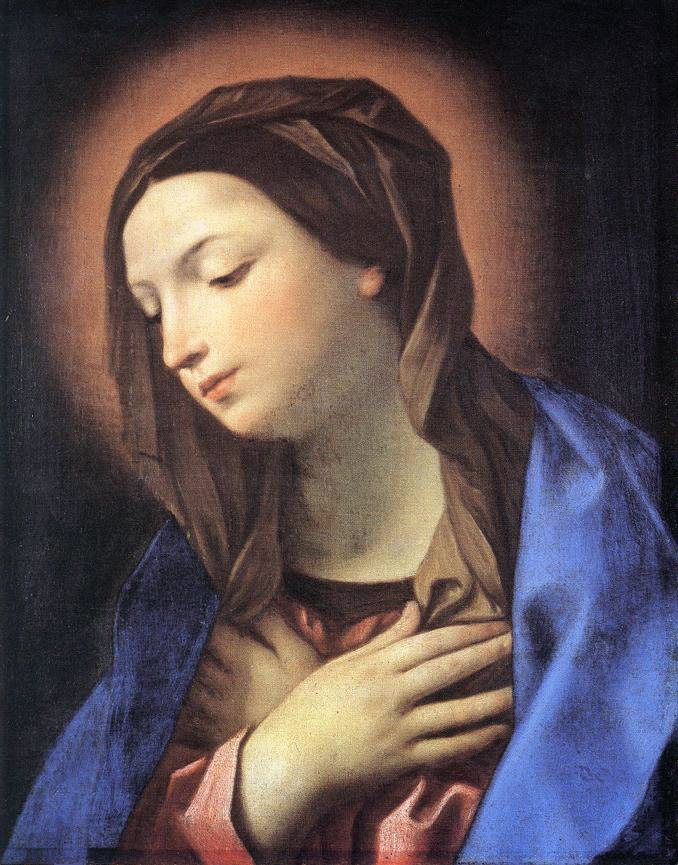
"Virgin of the Annunciation"
Guido Reni (1575-1642)


"Da pacem Domine" (Give peace, Lord)
Composed by Arvo Pärt
Performed by the Estonian Philharmonic Chamber Choir

Lord Jesus, where there is division between your followers, bring the peace of true unity in reunion and reconciliation. Let all who love you, seek the peace of true unity in your Body, the Church. Let love awaken all of us who have defined unity down or forgotten full visible unity and settled for division or the mere appearance of peace. May we reach out to each other, with the gift of love, born by the Holy Spirit, who is both Love and Gift. Reveal what divides us, and defeat it with the truth in love, through the power of your Holy Spirit. Love who seeks perfect unity, since you live in us, stir us up to seek perfect unity and true peace. Shine the light of divine truth, and defeat the deception that disregards true unity. Heal our divisions, and make us truly one, so that we may have true peace, the perfect peace of the community of the three Persons of the Holy Trinity. Blessed Theotokos, pray for us your children, that we may be one in your Son, our Lord Jesus Christ.

"For God is not a God of confusion but of peace, as in all the churches of the saints." (1 Corinthians 14:33)

"Finally, brethren, rejoice, be made complete, be comforted, be like-minded, live in peace; and the God of love and peace will be with you." (2 Corinthians 13:11)

"But the fruit of the Spirit is love, joy, peace, patience, kindness, goodness, faithfulness" (Gal 5:22)

"Being diligent to preserve the unity of the Spirit in the bond of peace." (Eph 4:3)

"And the peace of God, which surpasses all comprehension, will guard your hearts and your minds in Christ Jesus." (Philippians 4:7)

"Let the peace of Christ rule in your hearts, to which indeed you were called in one body; and be thankful" (Col 3:15)

"Live in peace with one another." (1 Thess 5:17)

"Now may the Lord of peace Himself continually grant you peace in every circumstance. The Lord be with you all!" (2 Thess 3:16)

"Not addicted to wine or pugnacious, but gentle, peaceable, free from the love of money." (1 Tim 3:3)

In our own strength we can do nothing. But God can do what we thought unimaginable. I am committed to pray daily for the full visible unity of all Christians. If you haven't done so already, will you too make this commitment? If so, please invite others to do so as well. Even though we may disagree on many things, let's agree to make this our daily prayer, and, insofar as possible, that of Christians around the world. "Lord Jesus, may all Christians be reunited in full visible unity, that we may be truly one, as you and the Father are one. In the name of the Father, of the Son, and of the Holy Spirit, Amen."

Thursday, August 28, 2008

Peace through the Cross


"Crucifixion"
Simone Martini (1333)


The Cross cannot possibly fail.
Do we not adore it?
It too is a cause of our salvation.
God with woman's permission joined divinity to flesh.
Men with God's permission joined this flesh to wood,
That this tree would bear as fruit life eternal.

Where does this divine flesh draw men to Himself?
Precisely where flesh and wood remain joined together,
Men and women with the divine Life,
Extending arms and feet.

I lay myself down, embracing this my tree,
Our tree, His tree,
In total self-gift -- for you for Him, from me from Him,
My dear brother, my dear sister,
That we may be truly one,
And make glad His sacred heart once wounded for our peace.

When His heart was pierced, so was hers,
For they were joined in love.
And for that same love,
So too does His Bride expose her side.
Here, on this tree,
This divine flesh draws men into one.

Did not this tree bear the Prince of Peace?
All those who seek peace, will find Him on this tree,
Extending arms and feet in union with our Lord.
He was oppressed and He was afflicted,
Yet He did not open His mouth.
Like a lamb that is led to slaughter,
And like a sheep that is silent before its shearers,
So He did not open His mouth.

On this Cross the world was overcome.
On this Cross the world will be overcome.
On this Cross God joined to man triumphed.
On this Cross man joined to God triumphs.
Man joined to wood is man joined to God.
Do we not adore this wood?

Here is the burning bush that could not be consumed,
Around which the ground was sacred.
Why could it not be consumed?
Because Love alone, in giving Himself up for consumption
Cannot be consumed.
Love is the endless font of self-giving.
Wood attached to Love cannot be consumed,
Even while it blazes.
This Cross cannot possibly fail.

Come Cross of Christ, hallowed tree,
And curse made blessing.
Graciously allow us to follow Him.
Bear His Body as you did then.
That we with Him may overcome the world,
In union with His passion and death,
Drawing all men fully unto Himself,
Into His precious Body, His Bride
With the glorious and most perfect unity
Of the Blessed Trinity.
Amen.

Saturday, July 12, 2008

St. Augustine on praying for non-Catholic Christians

The second reading in the Liturgy of the Hours this past Tuesday was from a discourse on the Psalms by Saint Augustine, bishop of Hippo (354 - 430). A friend pointed me there, because we were talking about the PCA study committee's report on Catholic baptisms, which I discussed recently here. My friend's mother had been baptized as a Catholic, but then Presbyterians rebaptized her when she became a Presbyterian, telling her that her Catholic baptism was invalid. St. Augustine was a Catholic bishop, writing to fellow Catholics, about the Donatists. The Donatists did not accept Catholic baptisms as valid. I ask my readers who are Catholic to pray with me, as St. Augustine enjoins, for our brothers and sisters in Christ who are presently separated from us by schism, and especially for those who do not even regard us as brothers in Christ. We are called to love them and pray for them, and regard them in all sincerity as our brothers and sisters in Christ, even when they regard us as apostates and heretics. St. Augustine writes:


We entreat you, brothers, as earnestly as we are able, to have charity, not only for one another, but also for those who are outside the Church. Of these some are still pagans, who have not yet made an act of faith in Christ. Others are separated, insofar as they are joined with us in professing faith in Christ, our head, but are yet divided from the unity of His body. My friends, we must grieve over these as over our brothers. Whether they like it or not, they are our brothers; and they will only cease to be so when they no longer say our Father.

The prophet refers to some men saying: When they say to you: You are not our brothers, you are to tell them: You are our brothers. Consider whom he intended by these words. Were they the pagans? Hardly; for nowhere either in Scripture or in our traditional manner of speaking do we find them called our brothers. Nor could it refer to the Jews, who did not believe in Christ. Read Saint Paul and you will see that when he speaks of "brothers," without any qualification, he refers always to Christians. For example, he says: Why do you judge your brother or why do you despise your brother? And again: You perform iniquity and commit fraud, and this against your brothers.

Those then who tell us: You are not our brothers, are saying that we are pagans. That is why they want to baptize us again, claiming that we do not have what they can give. Hence their error of denying that we are their brothers. Why then did the prophet tell us: Say to them: You are our brothers? It is because we acknowledge in them that which we do not repeat. By not recognizing our baptism, they deny that we are their brothers; on the other hand, when we do not repeat their baptism but acknowledge it to be our own, we are saying to them: You are our brothers.

If they say, "Why do you seek us? What do you want of us?" we should reply: You are our brothers. They may say, "leave us alone. We have nothing to do with you." But we have everything to do with you, for we are one in our belief in Christ; and so we should be in one body, under one head.

And so, dear brothers, we entreat you on their behalf, in the name of the very source of our love, by whose milk we are nourished, and whose bread is our strength, in the name of Christ our Lord and His gentle love. For it is time now for us to show them great love and abundant compassion by praying to God for them. May He one day give them a clear mind to repent and to realize that they have nothing whatever to say against the truth; they have nothing now but the sickness of their hatred, and the stronger they think they are, the weaker they become. We entreat you then to pray for them, for they are weak, given to the wisdom of the flesh, to fleshly and carnal things, but yet they are our brothers. They celebrate the same sacraments as we, not indeed with us, but still the same. They respond with the same Amen, not with us, but still the same. And so pour out your hearts for them in prayer to God. (Discourse on Psalm 32,29)

Friday, May 30, 2008

Solemnity of the Most Sacred Heart of Jesus


Today, the Friday after the second Sunday after Pentecost, is the Solemnity of the Sacred Heart of Jesus. What is the passion of Christ's Sacred Heart? Pope Benedict, in his book Behold the Pierced One, writes:


"We see who Jesus is if we see him at prayer. The Christian confession of faith comes from participating in the prayer of Jesus, from being drawn into his prayer and being privileged to behold it; it interprets the experience of Jesus' prayer, and its interpretation of Jesus is correct because it springs from a sharing in what is most personal and intimate to him".

One of Jesus' most personal and intimate moments with us, when He openly discloses His Sacred Heart to us, is described in John 17 when Jesus prays to His Father. As we 'listen in' on Jesus' prayer to the Father, we are hearing one Person of the Trinity talk to another Person of the Trinity. We are even hearing the heart of the Father, for as St. John tells us, Jesus, "the only begotten God who is in the bosom [κόλπον] of the Father, has revealed [ἐξηγήσατο] the Father." (St. John 1:18)

This is an amazing privilege. When a friend opens his or her heart to another friend, this is an invaluable gift, a gift of the heart; no material good can match it in value. The very act speaks, saying "I trust you". The very act of opening one's heart is thus an act of love, and it moves our heart to respond in gratitude and tenderness and even a kind of reverence, because we perceive the immense value of what has been given to us, a kind of participation in the heart of another person.

Even more so, when Christ opens His heart to us, in letting us hear His prayer to the Father, this is an act of tremendous love and humility toward us. He is making Himself vulnerable to us, entrusting us with His heart, allowing us to receive His heart with gratitude and joy, or reject it with apathy or preference for other things. If we receive the Sacred Heart He opens to us in John 17, we experience there His blessed communion with the Father, that eternal activity of His heart in which He receives from and gives back to His Father the most perfect love and fellowship, the most transparent and unreserved union of hearts, of which all human friendships are a mere imitation.

In John 17 we are hearing what is going on 'inside' God, inside the Trinitarian community of divine Persons. We are being given the amazing gift of a glimpse inside the Trinity. And what do we hear? We hear Jesus asking the Father that all Christ's followers would be one, as He and the Father are one. The unity of His people is the passion of Christ's Sacred Heart. And that is because unity is the telos (goal, aim, end) of love. We cannot claim to love one another, and not be seeking unity with one another. (See here). And because human persons are embodied, love between human persons involves visible unity, as I showed in "Sex, Dualism, and Ecclesial Unity". The passion of Christ's Sacred Heart is the *visible* unity of all His disciples.

Today I came across the following photograph, taken in Belfast:


The "peace wall" in Belfast, dividing Catholics and Protestants
Source: Phil Chevalier, via Dave Armstrong)

This wall apparently had to be extended upward, because Catholics and Protestants were throwing things over it, in their hostility toward one another. This wall is not a failure to demonstrate visibly an underlying pristine unity; rather, this wall is a visible, bodily expression of an underlying disunity at the level of heart, soul, mind and body.

The love that seeks the unity of all Christ's followers, the love revealed in Christ's Sacred Heart through His prayer in John 17, seeks to break down such walls, and especially the wall of hatred and separation that these physical walls instantiate (Eph 2:14).

My dear brothers and sisters in Christ, let us resolve, with the help of God's grace, to tear down this wall, and that in our hearts on account of which such a wall was built. Let us come in humility and repentance and charity to the ecumenical table, and seek full visible unity with each other, having hearts with like passion as that of our Savior Jesus Christ. He freely offers His heart to us in love; let us do likewise to one another.

Dear Lord Jesus, we ask you to join our hearts to your Most Sacred Heart. Forgive us our sins. May the passion of Your Most Sacred Heart be also the passion of our hearts, in union with You. Please tear down those walls that divide us from each other. And please use us to do so, not by our worth or strength, but in our weakness, through our sacrifices of love in imitation of your ultimate sacrifice of love. In the name of the Father, and the Son, and of the Holy Spirit. Amen.

Monday, April 14, 2008

A meditation on the Crucifix


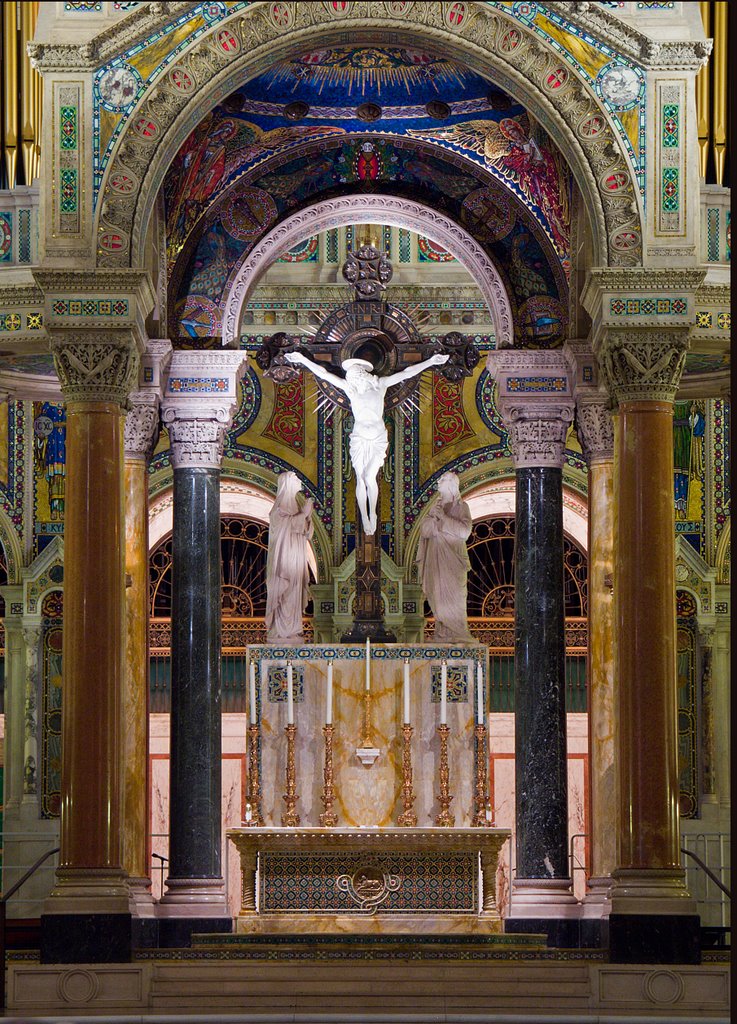
(Click on the photo to see a different photo of this Crucifix.)

At Mass at the Cathedral Basilica of Saint Louis I often meditate on the Crucifix, because the Crucifix represents incarnate Love in His most loving act. Here before me is what I am to become, what I am to long to become, that I might participate in "the fellowship of His sufferings, being conformed to His death." (Phil 3:10) But what is here before me? Here before me is death, death preceded by unbelievable suffering and agony. I must therefore long for suffering and death. For its own sake? No, for Love, and for all those Love loves. Why must suffering and death be necessary for Love? (Luke 24:26) Love says, "unless a grain of wheat falls into the earth and dies, it remains alone." (John 12:24) Love, by its very nature, cannot be alone; Love is always for others, even when abandoned by them. To live for others, I must die. I must embrace death, and all its accompanying sufferings, in order to give life to others, and to give glory to Love, who is Life. Love "does not act unbecomingly; it does not seek its own, is not provoked, does not take into account a wrong suffered. " (1 Corinthians 13:5) Love is like this in us only through the embrace of suffering and death. Love does not take into account a wrong suffered, because Love has embraced suffering. Love is not provoked, because Love has embraced death. To love, and to love Love, is to embrace suffering and death for the sake of Love and the love of Love.

The greater suffering Love suffered was not His physical suffering; it was the suffering of rejection and betrayal, abandoned by those He loved, scorned and mocked by His own people. That this was His greater suffering can only be understood by those who have loved deeply. Love was rejected and abandoned by those He most loved, those to whom He had poured out His heart. "He came to His own, and those who were His own did not receive Him." (John 1:11) The greater the love, the greater the suffering when that love is rejected. And Love's love is unlimited, hence His suffering in soul was unfathomable. In the lowest level of Dante's hell are the betrayers, and in the lowest zone of that level are those who betrayed their own lords and benefactors. Why is this sin so great? Because it is the most contrary to Love. To turn against those who love us, and to repay them evil for good, and hatred for love, especially when they have opened their hearts to us in love, is to cause them the greatest suffering. This suffering too Love embraces.

Those to whom Love came and revealed Himself and opened His heart, turned their backs on Him. But He says, "I gave My back to those who strike Me" (Isaiah 50:6). They praised Him on Palm Sunday, referring to Him as a King. He opened His heart to them and wept in front of them. (Luke 19:41) But a few days later they demanded that He be crucified. They had not the sensitivity or empathy even to bear with Him in the garden, where He obviously was longing for the support of their companionship. "Could you not keep watch with Me for one hour?" (Matthew 26:40) To be united to Love is to embrace rejection and betrayal by friends and family, not just persecution by enemies of the Lord.

To be a Christian (i.e. a Christ-follower), I must be like Christ, allowing my hands and feet to be stretched out and pinned to my instrument of death, my instrument of eternal life. Thus nailed, I am made immobile, dying to that natural clinging instinct to avoid death at all costs. I am to bear the shame of my indignity exposed. I am to be silent in the face of those who ridicule me (1 Peter 2:21-23). I am to turn my cheek to those who pluck my beard. (Isaiah 50:6) I am to allow my heart to be pierced in violence, even by those whom I love dearly. To be a Christian, to share Christ's cross, is to carry around suffering and death in my body. St. Paul tells us this very thing, saying that we are "always carrying about in the body the dying of Jesus, so that the life of Jesus may also be manifested in our bodies." (2 Corinthians 4:10) To be a Christian is to love to the point of suffering deeply. Can we carry around in our bodies the pierced heart of Jesus, and not allow our own hearts to be pierced?


Is it only death that is before me as I look upon the Crucifix? No. It is Life that is before me. Life is found in this death. This is the death that death cannot hold, the death that overpowers death and gives Life. (Acts 2:24) Do we really understand what it means that "man shall not live by bread alone, but by every word that proceeds from the mouth of God"? (Matthew 4:4) If I were a mere beast, I could live by bread alone, at least so far as I (as mere beast) could determine. But insofar as we try to live on bread alone, we treat ourselves as though we are mere beasts. "Let us eat and drink; for tomorrow we shall die." (Isaiah 22:13; 1 Corinthians 15:32) It is precisely because we are made in the image of God that we cannot live on bread alone. "Our hearts are restless until they find their rest in Thee." (St. Augustine, Confessions, I) If we try to live only for bread, we treat our lives as meaningless and hopeless, and we thus die, for man cannot live without meaning or hope. In the encyclical Spe Salvi, Pope Benedict writes, "Tantummodo cum futurum certum est uti realitas positiva, tunc praesens dignum est ut vivatur." (Only when the future is certain as a positive reality does it become possible to live the present as well.) This is what is meant by "man does not live by bread alone". The gospel of Life makes no sense to those who conceive of life as nothing more than metabolism. Our gospel message includes this message: Awake, you without hope, to your hopelessness and the impossibility of bread giving you hope or life or meaning, the very things you as bearers of God's image crave above all else, and without which you wither and die.

But the gospel message is not just negative. Before me represented in the Crucifix is the very "Word that proceeds from the mouth of the Father", the "Living Bread that came down from Heaven". To eat this Bread is to receive Eternal Life. This Word says:
"For the Bread of God is that which comes down from Heaven, and gives Life to the world. ... I am the Bread of Life; he who comes to Me shall not hunger, and he who believes in me shall never thirst. ... I am the Bread of Life. Your fathers ate the wilderness, and they died. This is the Bread which comes down from Heaven, that a man may eat of it and not die. I am the Living Bread which came down from Heaven; if anyone eats of this Bread, he will live for ever; and the Bread which I shall give for the life of the world is my flesh. ... Truly, truly, I say to you, unless you eat the flesh of the Son of man and drink His blood, you have no life in you; he who eats my flesh and drinks my blood has eternal life, and I will raise him up at the last day. For my flesh is food indeed, and my blood is drink indeed. He who eats my flesh and drinks my blood abides in me, and I in him. As the living Father sent me, and I live because of the Father, so he who eats me will live because of me. This is the Bread which came down from Heaven, not such as the fathers ate and died; he who eats this Bread will live forever." (John 6)
In the Eucharist I receive the Bread of Heaven, and my heart is no longer restless, for now I truly Live, not as a mere beast, but fulfilled in my nature as a being made in the image of God. Before me, represented in the Crucifix, is the Love by which I am Loved and Fed, and by which I am given true meaning and hope, a participation in Eternal Life Himself. Love's suffering and death, represented before me in the Crucifix and in which I participate in this present life, is "not worthy to be compared with the glory that is to be revealed to us." (Romans 8:18)

Only by this Love, with its accompanying embrace of suffering and death, can the divisions between Christians be overcome. Love seeks to work through us to do what Love does, bring unity. Why does Love seek to work through us? Pope Leo XIII wrote:

"Although God can do by His own power all that is effected by created natures, nevertheless in the counsels of His loving Providence He has preferred to help men by the instrumentality of men. And, as in the natural order He does not usually give full perfection except by means of man's work and action, so also He makes use of human aid for that which lies beyond the limits of nature, that is to say, for the sanctification and salvation of souls." (Satis cognitum, 2)
"For to this you have been called, because Christ also suffered for you, leaving you an example, that you should follow in His steps." (1 Peter 2:21)

While my heart still beats I wish to follow Christ's example, loving deeply "from the heart" (1 Peter 1:22), stretching out my hands and feet, so that my heart too may be pierced, and in Love I may embrace the suffering and death of His cross. In that Love, in union with His sacred heart, is Life Abundant (John 10:10), and overflowing joy, for Love tells us that our "sorrow shall be turned into joy" (John 16:20). By following in His steps we participate in His joy (John 17:13), the joy He receives in loving us and sacrificing Himself for us (1 Thess 2:19-20), the very joy for which He endured the cross. (Hebrews 12:2)

Lord Jesus, teach us from Your cross. Unite your people, in love, through us, as we follow your example on the cross, embracing in ourselves Your suffering and death.

In the name of the Father, and of the Son, and of the Holy Spirit. Amen.

Friday, January 25, 2008

Day 8 of the Church Unity Octave

Today is the last day of the Church Unity Octave. Today is also the feast of the conversion of St. Paul the Apostle. The conversion of St. Paul shows us that God is capable of turning opposing hearts toward Him in truth. After his conversion, St. Paul worked harder than all of them, though it was the grace of God working in him. (1 Corinthians 15:10) May our Lord Jesus raise up such figures today, to bring unity to all His followers.

Pope Benedict gave an address on Wednesday titled: On Christian Unity.

He closed this week of prayer for Church unity by speaking of the history of the advance of ecumenicism (Benedict XVI: Ecumenical Cause Is Advancing), and pointing to the role that prayer has played in that advance (Pope Says Prayer Got Ecumenical Wheels Turning).

May the Lord unite all His people, in true unity. With God all things are possible.

Thursday, January 24, 2008

Day 7 of the Church Unity Octave

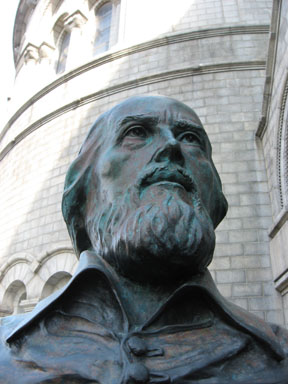
Today is the feast day of St. Francis de Sales, bishop of Geneva and Doctor of the Church. He lived from 1567-1622. The bust at right is located on the west side of the St. Louis Cathedral Basilica. My wife took this photo late last year.

Two of his books have been very edifying to me. One is his Introduction to the Devout Life. The other is now published under the title: The Catholic Controversy: St. Francis de Sales' Defense of the Faith.

The latter book was written in the form of pamphlets to the Calvinists of the Chablais region of France, south of Geneva. He did not originally intend to write these pamphlets. As he went from house to house to talk with the Calvinists, they repeatedly refused to talk with him or even listen to him. So he started writing the pamphlets, and distributed them under doors in the villages and towns. Through his work in this region over the course of four years (from 1594 to 1598), 72,000 Calvinists were brought back into the Catholic Church.

One of the most important points in these pamphlets is that the Church comes from the Apostles, as the Apostles come from Christ, and as Christ comes from the Father. The Father sent the Son. The Son authorized and commissioned the Apostles. The Apostles authorized and commissioned the bishops. And these bishops authorized and commissioned bishops. This is a top-down transmission of divine authority, from the Father, through the Son, through the Apostles, and through the bishops. Only those sent by the Apostles should be received by Christians, and thus only those sent by the bishops sent by the Apostles should be received by the Christians. We should not follow those who are self-sent, or self-appointed, for they are not authorized by Christ to shepherd the Lord's sheep. Anyone can claim to be authorized, but only those who have been appointed by those whom the Apostles sent are actually authorized. In this way the unity of the Church flows directly from the unity of Christ Himself; just as an organism grows, the Church retains within itself the unity it received directly from the incarnate Christ, its Head. "We are to grow up in all aspects into Him, who is the head, even Christ from whom the whole body, being fitted and held together by that which every joint supplies ...." (Ephesians 4:16)

Recently I wrote, "I think there are two fundamentally different ways of trying to find the Church. One compares form, the other traces matter. As far as I can tell, one of those two ways must take priority." Comparing form (i.e. comparing one's own interpretation of Scripture to the various denominations' statements of faith, and finding the closest fit) is a method that is intrinsically disposed to disunity. The divisions that arise by way of that method are interminable if sought to be removed by that method. That is because the method itself is a large part of the cause of the division. The method carries with it an implicit assumption that there is no authoritative interpretation, no magisterium. That is the significance of this statement by Tertullian and this statement by St. Vincent of Lerins. When the Apostles were alive, their interpretation of their own writings was the authoritative interpretation. And from the first generation after the Apostles, the Church has always believed that the authoritative interpretation belonged to those whom the Apostles appointed (i.e. the bishops). The "compare form" way of finding the Church leaves out the matter; it de-materializes the Church. In that way, it de-materializes the 'joints' that connect each member to Christ the Head.

So if comparing form is not the way to find the Church, then what does it mean to "trace matter"? The sacramental successions, from bishop to bishop all the way back to the Apostles and through the Apostles to Christ, are the material 'joints' that connect us to Christ. That is why the unity of the Church (i.e. the Body) depends on finding and following only those bishops who have this succession, i.e. are connected by these joints all the way back to the Apostles. This is why recognizing the nature and importance of Apostolic succession is essential for ecumenical unity. Recently, in this conversation, a Protestant named John asked me the following question: "How do you identify the true church?" In reply I wrote something that I would write to any Protestant:


We identify the true Church by going back to Jesus. We know that Jesus founded a Church. Now the key is to keep your finger on that thing that Jesus founded, and move forward through history, century by century, until you reach the present day. Don't go quickly. Read the writings of the fathers of the first century, then the second century, and then third century, and then the fourth century, and then the fifth century. Now, whenever there is a schism, you have to determine which is the split off (at least in some respect), and which is the continuation of the Church that Christ founded. How did the fathers determine which is the continuation of the Church Christ founded, and which is the schism from that Church? Notice the roles of the Ecumenical Councils. Notice also the role of the Pope in the authority of the Ecumenical Councils. (I'm not trying to be patronizing in this paragraph -- I'm simply laying out how I think the true Church is to be found. I'd be interested in how you agree/disagree with that general methodology, and where in history our 'fingers' part ways, so to speak, and at that very point where our fingers part ways, why your finger goes away from mine.)
The only way, in my opinion, for all Christians to be reunited in one Body is to retrace our steps conceptually to the various points in history at which we came apart. Then we need to dialogue about the principled way by which, in every case in which there is a schism of some sort, we can determine which is the "schism from" the true Church, and which is the continuation of the true Church.

I stood in front of the bust (in the photo above) this morning before mass, and asked St. Francis to pray for us, that we might be made one in the truth, and in the love of the truth. May we have a double portion of his passion to reconcile all souls with Christ, by reconciling them with Christ's Body, the Church. Lord Jesus, we need Your help. We need You to help us to be truly united as You desire us to be. Help us Lord to find and unite to the true shepherds that You have appointed. And help us Lord to love our brothers and sisters in Christ, with such love that we seek out and hold on to true unity, and ward off all attacks against our unity. In the name of the Father, and of the Son, and of the Holy Spirit. Amen.

Wednesday, January 23, 2008

Day 6 of the Church Unity Octave


On the right is a photo from November 9, 1989. East Germans are scrambling to get over the Berlin Wall; West Germans are reaching over to help them. I remember that day. From the time of the construction of the wall, at least 125 persons had been killed by East German guards while trying to cross it. That is part of what made it so incredible and moving to see hundreds of people climbing over the wall.


Soon the hammers were flying.


Even pieces of the wall were used against it.


The walls that separate Christians from each other are not made of concrete. They are composed of mistrust, ignorance, confusion, misconception, misunderstanding, bitterness, pride, apathy, cowardice, impatience and coldness. These walls come down only by means of love, prayer, humility, forgiveness, listening, patience, hope, faith, courage, study, trust, receptivity and friendship. If faith can move mountains, then surely it can break down these walls. If God is love, and we are the people of God, then surely we too will pick up our hammers and begin to tear down the walls that divide us. Do we believe that God is able to do this, through us, in our time? If so, then let us tie ourselves in love to the table of ecumenical dialogue, and cast ourselves in prayer before the throne of heaven. The truth is both found and communicated in love; love both seeks and gives the truth.

Lord Jesus, we ask You to help us break down the walls that divide us. Nothing is impossible for You. Without You, we can do nothing. But only say the word, and it shall be done. Please reconcile us with each other, that we may be truly one, in the peace and unity of Your Kingdom. In the name of the Father, and of the Son, and of the Holy Spirit. Amen.

Monday, January 21, 2008

Day 4 of the Church Unity Octave

In his address yesterday, Pope Benedict said the following:
Dear Brothers and Sisters!

Two days ago began the Week of Prayer for Christian Unity during which Catholics, Orthodox, Anglicans and Protestants, knowing that their divisions constitute an obstacle to the reception of the Gospel, together implore the Lord, in a yet more intense way, for the gift of full communion. This providential initiative was born 100 years ago, when Father Paul Wattson started the "Octave" of prayer for the unity of all the disciples of Christ. Today for this occasion the spiritual sons and daughters of Father Wattson, the friars and sisters of the Atonement, are present in St. Peter's Square and I greet them cordially and encourage them to pursue the cause of unity with their special dedication.

We all have the duty to pray and work for the overcoming of every division between Christians, responding to Christ's desire "
ut unum sint." Prayer, conversion of heart, the reinforcement of the bonds of communion, form the essence of this spiritual movement that we hope will soon lead the disciples of Christ to celebrate the Eucharist together, the manifestation of their full unity.

This year's biblical theme is dense with meaning: "Pray without ceasing" (1 Thessalonians 5:17). St. Paul addresses himself to the community of Thessalonica, which was experiencing internal clashes and conflicts, to remind them with insistence about certain fundamental attitudes, among which there stands out, indeed, incessant prayer. With this invitation of his, he wants it to be understood that from the new life in Christ and in the Holy Spirit there flows forth the capacity to overcome all egoism, to live together in peace and fraternal union, to bear in large measure the burdens and sufferings of others. We must never tire of praying for the unity of Christians! When Jesus, during the Last Supper, prayed that his disciples "be one," he had a precise goal in mind: "That the world believe" (John 17:21).

The Church's evangelizing mission, therefore, moves along the path of ecumenism, the path of unity of faith, of evangelical witness and authentic fraternity. As is done every year, on Thursday, Jan. 25, I will go to the Basilica of St. Paul Outside the Walls to conclude the Week of Prayer for Christian Unity with solemn vespers. I invite Romans and pilgrims to join with me and with Christians of all the churches and ecclesial communities who will take part in the celebration, to ask of God the precious gift of reconciliation among all the baptized.

May the Mother of God, whose appearance to Alphonse Ratisbonne in the Church of Sant'Andrea delle Frate in Rome we remember today, obtain from the Lord the abundance of the Holy Spirit for all disciples in such a way that we can arrive at perfect unity and in this way offer the witness of faith and life that the world urgently needs.
Lord Jesus, please give us a change of heart regarding our divisions. Remove our sinful pride, and help us to desire your glory and honor above all else. May we no longer be content to remain divided from each other. Tear down these walls of blindness and pride that separate us, and grant us the peace and unity of your kingdom. May we be given the gift of reconciliation among all the baptized. In the name of the Father, and of the Son, and of the Holy Spirit. Amen.

Sunday, January 20, 2008

Day 3 of the Church Unity Octave

Today is the third day of the Church Unity Octave. The following is from today's readings in the Liturgy of the Hours. It is from the letter of St. Ignatius (d. 107 AD), bishop of Antioch, to the Ephesians:
"It is right for you to give glory in every way to Jesus Christ who has given glory to you; you must be made holy in all things by being united in perfect obedience, in submission to the bishop and the presbyters. ... I am taking the opportunity to urge you to be united in conformity with the mind of God. For Jesus Christ, our life, without whom we cannot live, is the mind of the Father, just as the bishops, appointed over the whole earth, are in conformity with the mind of Jesus Christ. It is fitting, therefore, that you should be in agreement with the mind of the bishop as in fact you are. Your excellent presbyters, who are a credit to God, are as suited to the bishop as strings to a harp. So in your harmony of mind and heart the song you sing is Jesus Christ. Every one of you should form a choir, so that, in harmony of sound through harmony of hearts, and in unity taking the note from God, you may sing with one voice through Jesus Christ to the Father. If you do this, he will listen to you and see from your good works that you are members of his Son. It is then an advantage to you to live in perfect unity, so that at all times you may share in God. If in a short space of time I have become so close a friend of your bishop -- in a friendship not based on nature but on spiritual grounds - how much more blessed do I judge you to be, for you are as united with him as the Church is to Jesus Christ, and Jesus Christ to the Father, so that all things are in harmony through unity. Let no one make any mistake: unless a person is within the sanctuary, he is deprived of God's bread. For if the prayer of one or two has such power, how much more has the prayer of the bishop and the whole Church?"
According to St. Ignatius, how are we made holy in all things? By being united to the bishop in perfect obedience. Is unity optional? No, since God is not double-minded, and we are to be united in conformity with the mind of God, we all are to have the same mind, by conforming to the mind of God. How do we conform to the mind of God? By conforming to the mind of the One whom God sent, i.e. Christ. How do we conform to the mind of Christ? By conforming to the mind of those whom Christ sent, i.e. the Apostles. How do we conform to the mind of the Apostles? By conforming to the mind of those whom the Apostles sent, i.e. the bishops. In this way, in our unity we form a harmony, since each is given a different role, but all are ordered together in a hierarchical unity. In order to be united in perfect harmony, we must all be united in conformity to the mind of the true shepherd (i.e. bishop) of the pasture where we live (i.e. diocese).

How do we determine who is the true shepherd? Do we look at all those who claim to be shepherds, and then pick the one that we like the most, or that (from our point of view), seems to feed us most, or that teaches our own interpretation of Scripture? No. That is consumerism. That is a sure way to fall prey to false teachers, to those who do not "enter by the door into the fold of the sheep, but climb up some other way" (St. John 10:1). False teachers "climb up some other way" by not coming to the sheep through the Apostles and the succession of bishops appointed by the Apostles. Those not sent to us by the Church are false teachers; they are self-appointed. We determine the true shepherd of our diocese by finding the person whom the Church sent to shepherd our diocese. When we are in union with our true shepherd, and our true shepherd is in union with the Church that sent him, then we possess unity with Christ, as He is in unity with the Father.

Those who reject the authority of bishops, by denying the sacramental distinction between bishops and presbyters, must dismiss St. Ignatius's teachings concerning the distinction between bishops and presbyters as a late first-century accretion, which must not be essential, because otherwise it would be in the New Testament. Their assumption, entirely unjustified by Scripture itself, is that the Scripture contains an exhaustive and explicit ecclesiology for the post-Apostolic era. Even though the Apostle John died about seven years before St. Ignatius wrote his letters, and even though the Apostle John lived and worked in the very area in which were located the churches to which St. Ignatius addressed his letters, those who reject the authority of bishops seemingly must claim that in those seven years, all those churches (and the church at Antioch) fell into the error of believing (1) that bishops had greater authority than presbyters, (2) that bishops were the successors of the Apostles in a way that presbyters were not, (3) that every church should if possible have a bishop, and (4) that this system of church government was Apostolic in origin, and not optional or provincial or conventional. In claiming that the Church fell into such serious error by the end of the first century, such persons are succumbing to the same ecclesial deism present in Mormonism. As Jesus and His Church are inseparable, so faith in Jesus and faith in His Church are inseparable. Ecclesial deism is for this reason not just a lack of faith in the Church, it is a lack of faith in Jesus Himself.

Lord Jesus, please help all who seek to follow you to see what are the fundamental points that divide us, so that by your grace we may overcome the divisions that separate us, and live in perfect harmony with each other on earth, as you live in perfect harmony with the Father in Heaven. Help us to recognize as secondary, differences that are in fact dependent on more fundamental points. Give us all an urgent desire to be united as one flock, with one faith, one baptism, under the one chief shepherd you have appointed (St. John 21:15-17).

Saturday, January 19, 2008

Day 2 of the Church Unity Octave

Today is the second day of the Church Unity Octave.

Lord Jesus, we grieve over our divisions. Through our divisions, we who are called to love one another, have become a mockery to the world. And in this way, we have dishonored Your Name to the world. Because we love You, we want to honor and glorify You before all men, by being united in truth and love with all Your disciples. We are divided in various ways: in our doctrines, in our sacraments, and in our government. When we cannot share the Eucharist together, then we are not united. Lord Jesus, please help us all to see that we are divided, and that You desire deeply that we be fully united in faith, worship, and government. Place in us all a longing, out of love for You, to be one with each other. And solidify our resolve to seek with untiring effort, relying on the power of your Holy Spirit, to be reconciled in complete unity with all our brothers and sisters in Christ from whom we are now separated by schism.

In the name of the Father, and of the Son, and of the Holy Spirit. Amen.

Friday, January 18, 2008

Day 1 of the Church Unity Octave

Lord of unity, Father, Son and Holy Spirit, we pray without ceasing that we may be one, as you are one. Father, hear us as we seek you. Christ, draw us to the unity which is your will for us. Spirit, may we never lose heart. Amen.

Today is the first day of the 100th Church Unity Octave, or "Week of prayer for Christian unity". Yesterday Zenit posted an article describing how much progress has been made toward unity over the past 100 years. Two days ago Pope Benedict invited the Church to pray without ceasing for "the great gift of unity among all the Lord's disciples." The meditation for this first day of the Octave can be found here. Please set aside time this week to pray for the full visible unity of all Christ's followers.

This day (January 18) was chosen for the beginning of the Octave because January 18 was one of the two feast days of the Chair of St. Peter, the other being February 22. The Catholic Encyclopedia article on the Chair of St. Peter explains that January 18 was the day St. Peter "held his first service" with the Christians of Rome, outside the city in the cemetery of the Via Salaria. The chair on which St. Peter sat there was (it is thought) destroyed by the Goths in the early fifth century. The other feast day (February 22) of the Chair of St. Peter has to do with the chair upon which St. Peter sat in Rome.

What does the chair of St. Peter have to do with Church unity? Everything. Consider the words of St. Cyprian, bishop of Carthage (d. 258). He writes,

"The Lord says to Peter: 'I say to you,' He says, 'that you are Peter, and upon this rock I will build my Church, and the gates of hell will not overcome it. And to you I will give the keys of the kingdom of heaven: and whatever things you bind on earth shall be bound also in heaven, and whatever you loose on earth, they shall be loosed also in heaven.' And again He says to him after His resurrection: 'Feed my sheep.' On him He builds the Church, and to him He gives the command to feed the sheep; and although He assigns a like power to all the Apostles, yet He founded a single chair, and He established by His own authority a source and an intrinsic reason for that unity. Indeed, the others were that also which Peter was; but a primacy is given to Peter whereby it is made clear that there is but one Church and one chair. So too, all are shepherds, and the flock is shown to be one, fed by all the Apostles in single-minded accord. If someone does not hold fast to this unity of Peter, can he imagine that he still holds the faith? If he desert the chair of Peter upon whom the Church was built, can he still be confident that he is in the Church?"
"There is one God and one Christ, and one Church, and one Chair founded on Peter by the word of the Lord. It is not possible to set up another altar or for there to be another priesthood besides that one altar and that one priesthood. Whoever has gathered elsewhere is scattering."
St. Cyprian is very explicit that Christ made St. Peter the ground (or foundation or basis) of the unity of the Church. (This does not, of course, in any way take away from Christ's role as the ground of the Church's unity; see my discussion of monocausalism if that is not clear.) In giving to St. Peter a primacy, Christ gave to the Church a gift, a means by which to preserve her unity. Otherwise at the first schism there would be no way to determine where the Church is, for each faction would seemingly have equal claim to be the continuation of the Church. Christ did not set up the Church so that all of her members must have graduate degrees in theology (as if even then there would be unity!) in order to determine where is the Church. St. Cyprian continues:

"With a false bishop appointed for themselves by heretics, they dare even to set sail and carry letters from schismatics and blasphemers to the chair of Peter and to the principal Church, in which sacerdotal unity has its source; nor did they take thought that these are Romans, whose faith was praised by the preaching Apostle, and among whom it is not possible for perfidy to have entrance."
Notice that for St. Cyprian, the unity of the bishops and priests has its source (not only as a past event but as a present grounding or principle) in the chair of Peter.

The bishops of the Council of Serdica (343-344) in what is today Sophia, Bulgaria concluded the summary of the acts of the synod by writing to the bishop of Rome with these words:

"For this will seem to be best and most fitting indeed, if the priests from each and every province refer to the head, that is, to the chair of Peter the Apostle."
St. Optatus of Milevisu, bishop of Milevis in Africa (367), writes:

"But you cannot deny that you know that the episcopal seat was established first in the city of Rome by Peter and that in it sat Peter, the head of all the apostles, wherefore he is called Cephas, the one chair in which unity is maintained by all. Neither do other Apostles proceed individually on their own; and anyone who would set up another chair in opposition to that single chair would, by that very fact, be a schismatic and a sinner. It was Peter, then, who first occupied that chair, the foremost of his endowed gifts .... I but ask you to recall the origins of your chair, you who wish to claim for yourselves the title of holy Church."
Optatus shows that schism is defined in relation to the chair of St. Peter, because Christ made Peter the head of the Apostles. That definition of schism is exactly what we see today in the Catechism of the Catholic Church (see here).

St. Jerome (340-420), writes:

"Since the East, shattered as it is by the long-standing feuds, subsisting between its peoples, is bit by bit tearing into shreds the seamless vest of the Lord.... I think it my duty to consult the chair of Peter .... As I follow no leader save Christ, so I communicate with none but your blessedness, that is with the chair of Peter. For this, I know, is the rock on which the church is built! This is the house where alone the paschal lamb can be rightly eaten. This is the ark of Noah, and he who is not found in it shall perish when the flood prevails.
"The church [here, i.e. Syria] is rent into three factions, and each of these is eager to seize me for its own. .... I meantime keep crying: "He who clings to the chair of Peter is accepted by me... Therefore I implore your blessedness, by our Lord's cross and passion, ..... to give an apostolic decision. Only tell me by letter with whom I am to communicate in Syria."
St. Jerome clearly recognized the role of the chair of Peter in preserving and grounding the unity of the Church. The church in Syria was at that time divided into three factions, and St. Jerome turned to the visible head of the Church (the bishop occupying St. Peter's chair) to determine which of the factions was part of the true Church, and which were schisms from the true Church. He clearly understand that Christ had foreseen that the Church needed a visible head in order not to provide an occasion for schism. St. Jerome writes:

"The Church was founded upon Peter: although elsewhere the same is attributed to all the Apostles, and they all receive the keys of the kingdom of heaven, the strength of the Church depends upon them all alike, yet one among the twelve is chosen so that when a head has been appointed, there may be no occasion for schism."
This statement shows that St. Jerome recognized that the unity of the Church was not based on a continuous miracle flying in the face of nature. Even nature teaches us that where there is no visible head, there will be no end of quarreling and divisions, to the point of disintegration. That is why Christ established a visible head, to provide a principium unitatis (principle of unity) for the Church. To be in communion with that rock upon which the Church is built, is to be in full union with the Church. To spurn that rock is to be in schism.

St. John Chrysostom (347-407), bishop of Constantinople, shows also an understanding of the difference in authority and jurisdiction between the episcopal chair of St. James in Jerusalem and the chair of St. Peter in Rome.

"And if any should say, 'How then did James receive the chair at Jerusalem?' I would make this reply, that He appointed Peter teacher, not of the chair [of Jerusalem], but of the world."
St. Augustine (354-430), bishop of Hippo, writes:

"... because [the bishop of Carthage] saw himself united by letters of communion both to the Roman Church, in which the primacy (principality/supremacy) of an apostolic chair [apostolicae cathedrae principatus] has always flourished ...."
And elsewhere St. Augustine points to the chair of St. Peter as one of the things that keeps him in the Catholic Church. He writes:

"There are many other things which most justly keep me in [the Catholic Church's] bosom. The consent of peoples and nations keeps me in the Church; so does her authority, inaugurated by miracles, nourished by hope, enlarged by love, established by age. The succession of priests keeps me, beginning from the very seat of the Apostle Peter, to whom the Lord, after His resurrection, gave it in charge to feed His sheep, down to the present episcopate. And so, lastly, does the name itself of Catholic, which, not without reason, amid so many heresies, the Church has thus retained; so that, though all heretics wish to be called Catholics, yet when a stranger asks where the Catholic Church meets, no heretic will venture to point to his own chapel or house. Such then in number and importance are the precious ties belonging to the Christian name which keep a believer in the Catholic Church ...no one shall move me from the faith which binds my mind with ties so many and so strong to the Christian religion.... For my part I should not believe the gospel except the authority of the Catholic Church moved me."
The testimony of the fathers shows that they recognized the role of St. Peter's chair (signifying the greater authority Christ gave to Peter as the head) in grounding and preserving the unity of the Church. St. Peter said to Jesus, "Lord, to whom shall we go? You have words of eternal life." (John 6:68) Christ, in response, made these same words apply to St. Peter, by making St. Peter the visible head of the Church. If we were to turn away from St. Peter, to whom shall we go? What other visible ecclesial authority has been given his authority and charism? No one. Likewise, if we wish to see all Christians united in full visible unity, we must be like St. Andrew, Peter's brother, who brought St. Peter to Jesus. (St. John 1:40-42) But we do so by bringing into fellowship with St. Peter those who presently are not in full communion with him.

Monday, January 7, 2008

Octave for the Unity of the Church

The Octave (i.e. eight days) for the Unity of the Church is coming soon. It begins on the [old day of the] feast of the Chair of St. Peter (January 18) and continues through the feast of the conversion of St. Paul (January 25). This year is the one hundredth anniversary of the Octave for the Unity of the Church. Prayers for each of the days of the Octave can be found here. This is a good time to prepare for the Octave. Consider fasting (in some respect) during the Octave and devoting more time each day of the Octave to pray for the unity of the Church. If you wish to pray a novena in preparation for the Octave, begin the novena on Wednesday, January 9. This is also a good time to speak with your priest/pastor to make sure that your parish/church offers prayers for the unity of the Church during the Octave. This year's theme is "Pray without ceasing". And prayer must be the foundation for our labors to unite all Christians in accordance with the sacred heart of Jesus, as revealed in His most self-disclosing prayer of St. John 17. We know that "Unless the Lord builds the house, those who build it labor in vain." (Psalm 127:1) And the Church is the household of God. (1 Timothy 3:15) Let us implore the Lord to help us bring unity to His people. "Blessed are the peacemakers, for they shall be called sons of God." (St. Matthew 5:9)

To bring peace to God's people, we must pursue and receive within ourselves Christ's peace, for we cannot give what we do not have. If our hearts are in turmoil and we are at war within ourselves, we should first seek the peace of Christ, which is a supernatural gift of grace. (Philippians 4:7) Only then can we truly be peacemakers (St. Matthew 7:3-5). We should seek to be reconciled to God, and to His Church. Those two reconciliations go together. Once reconciled, we are admonished with St. Peter (in ecclesial union with him) to return and strengthen our brothers (St. Luke 22:32), for only those who have strength can give strength, and only those who need strength should be strengthened. And so the peace-making responsibility rests most heavily on those who have obtained peace, for from those who have been given much, much is required (St. Luke 12:48). But may we all diligently pursue Christ's peace, being thereby reconciled to God, to each other and to ourselves. Christ desires to give us His peace, for He said to His Apostles: "Peace I leave with you; My peace I give to you." (St. John 14:27) To share in His peace is to share in the Life of the Blessed Trinity, for He Himself is our peace (Ephesians 2:14). To pursue Christ is therefore (as an implication) to pursue peace with all men. (Hebrews 12:14). St. Peter enjoins us to seek peace and pursue it. (St. Peter 3:11), and St. Paul enjoins us to pursue the things which make for peace and the building up of one another. (Romans 14:19) It is our obligation and privilege to participate in the reconciliation of God's people, in the making of peace in the body of Christ, for the glory of His name and for the sake of the effectiveness of the gospel in the world. (St. John 17:23)

Tuesday, November 20, 2007

Prayer

Dear Lord Jesus,

Please remake me, from a noisy gong and clanging symbol
Into the likeness of your Person.

Make me patient and kind.
Make me bear all things.
Make me believe all things.
Make me hope all things.
Make me endure all things.
Make me an instrument of your peace.

Help me to listen.
Help me to understand.
Help me to be gentle.
Help me to heal wounds.
Help me to carry the suffering of others.
Help me to bring unity to your people.

Bless all those who hear me.
Bless them in spite of my failings.
Bless those whom I have caused to stumble.
Bless those whom I have misunderstood.
Bless those who walk in confusion.
Bless all who seek the truth.

Be lifted up, that the world may see your Light.
Be raised high, that all may see your Beauty.
Be exalted above the earth, that all men may be drawn to You.
Be enthroned, that all may recognize your Majesty.
Be exalted, that all may sing your praises.
Be received in Zion, that all who love You may rejoice.

So that we may all be one,
That You may be glorified,
So that all the world may know
That the Father sent You,
And that the Father loves us,
Even as You love us.

In the name of the Father, and of the Son, and of the Holy Spirit. Amen.


Monday, November 12, 2007

St. Josaphat: Martyr for Unity

Today is the feast day of St. Josaphat of Polotsk, a "a martyr to church unity". (For more on St. Josaphat, see here.)

St. Josaphat, pray for us, that all Christ's followers may be one, as Christ and the Father are one.

Thursday, October 18, 2007

To Guide our Feet into the Way of Peace

Today is the Feast day of St. Luke the Evangelist. St. Luke records the prophecy of the high priest Zacharias, the father of John the Baptist. Zacharias prophecies that John the Baptist will "go on before the Lord to prepare His ways", and "to guide our feet into the way of peace." (St. Luke 1:76,79)

In St. Luke 12:49-53, Jesus shows us that the way of peace is necessarily one that involves conflict with the world, a certain kind of conflict with those who reject and hate Christ, as I have discussed here. But the way of peace must bring peace and unity to and among and between all those who love Christ. In these last days, we lift our heads to prepare for Christ's return. The Bride makes herself ready for His second coming. And again we need our feet to be guided into the way of peace. For if we are separated into myriad schisms, how can we say that we are walking in the way of peace? Shouldn't the way of peace lead us to be at peace with each other, united in faith, practice and governance? Shouldn't the followers of the "Prince of Peace" be at peace with each other? Shouldn't the way of peace necessarily involve being reconciled to our brothers and sisters in Christ (St. Matthew 5:24)? At the very least, shouldn't the way of peace involve an unrelenting impassioned effort on our part to be reconciled to our brothers and sisters from whom we are separated by schism? Can he who makes no such effort say to himself rightly, "I am walking in the way of peace"? St. Peter tells that we "must seek peace and pursue it" (1 Peter 3:11) If we are men and women of peace, men and women walking in the way of peace, then shouldn't we be seeking and pursuing peace with those in the household of faith from whom we are estranged? An individualistic notion of peace would concern itself only with our personal relation to Christ, and would not include our relation to our brothers and sisters in Christ. But the writer to the Hebrews commands us to "pursue peace with all men" (Hebrews 12:14). So how much more ought we to be pursuing peace with those within the "household of faith"?

Is all this mere idealism? A confusion of the already and the not yet? The writers of Scripture do not tell us to wait until the eschaton to pursue peace. The command is for Today, because the way of peace into which our feet are to be guided is for Today. The fractured state of Christendom can become so ordinary and familiar to us that calls and efforts to restore and retrieve peace and unity seem idealistic, radical and even foolish. But that is only because we have grown so accustomed to the state of schism that it no longer seems evil to us. The unity of the early Christians was such that they "were together and had all things in common" (Acts 2:44). We have to recover an awareness of the unity and peace that Christ gave to the Church (St. John 14:27), and which He desires us to maintain and pursue in His Household and His Body, the Church. We know that a "house divided cannot stand". (St. Matthew 12:25; St. Mark 3:25; St. Luke 11:17) And is it not a cancerous condition when a body contains cells or groups of cells that pursue an end of their own making, and not the good and unity of the whole body? It seems to me that we need to be spreading the following word to all believers, including those with whom we are already in full communion: "Come, let us fervently pursue peace and reconciliation with those believers who are presently estranged from us. Let us not rest until this reconciliation is achieved and the schisms removed. The Prince of Peace is coming soon. Let us prepare ourselves by making peace with each other."

Lord Jesus, may we be made one, as you and the Father are one. Make us instruments of your peace. In the name of the Father, and of the Son, and of the Holy Spirit. Amen.

Tuesday, October 16, 2007

How Not To Reform the Church

Step 1: Define some part of your own personal interpretation of the Bible to be the true "gospel", defending your definition by claiming that [your] gospel is what the Apostles taught but has since been lost, hidden, distorted and corrupted until now. Don't use the word 'interpretation'; if necessary call it 'exegesis' to make it seem entirely objective and scientific.

Step 2: Declare and assert, again based on your own personal interpretation of the Bible, that the preaching of the true "gospel" is one of the essential marks of the Church.

Step 3: Point out that only you and those who agree with you bear all the essential marks (as you yourself have defined them in Steps 1-2) of the Church, and that the rest of the so-called Church does not bear all these marks and is therefore apostate and not the true Church.

Step 4: Get yourself excommunicated by that so-called Church which (through Steps 1-3) you have just declared apostate.

Step 5: State that you believe in "semper reformanda", and vigorously oppose the notion that the magisterium is infallible, while also declaring that anyone who repeats Step 1 but comes to a different conclusion regarding the nature of the true "gospel" is ipso facto a heretic and/or an apostate. When asked how what you have done differs from forming a schism, assert that a schism would have a different gospel than the true "gospel" you have recovered.

Step 6: Celebrate your reformation of the Church every year on the anniversary of your initiation of Step 1, and declare and assert that the one, holy, catholic and apostolic Church continues only with you and those who agree with you regarding the content of the true "gospel".


Today is the memorial of St. Margaret Mary Alacoque (1647-1690), who helped us know more deeply the depth of love which flows continually from the Sacred Heart of Jesus. From that pierced heart flows the water and the blood by which through the sacraments the Church is fashioned into a Bride from and for the Second Adam. As St. John Chrysostom writes:

For "there came forth water and blood." Not without a purpose, or by chance, did those founts come forth, but because by means of these two together the Church consisteth. And the initiated know it, being by water indeed regenerate, and nourished by the Blood and the Flesh. Hence the Mysteries take their beginning; that when thou approachest to that awful cup, thou mayest so approach, as drinking from the very side.

At almost every Mass, for the past year, as I come before Christ in the Eucharist to drink from His very side, I experience a deep pain in the center of my soul. Usually it moves me to the point of tears. I have to remember always to bring a handkerchief to Mass. Sometimes, I struggle to restrain myself from open weeping. I do not fully understand this experience, but I do know that it has to do with the brokenness and division in Christ's Body. The best I can explain it is like this. Here I am, coming before the Living Christ to receive the Life that flows from His Sacred Heart. And yet while the Living Christ is being offered to me, His Sacred Heart is in pain, and He Himself is weeping over all those who are separated in schisms, wounding the integrity of His Body but not knowing what they are doing. He is weeping over their absence and estrangement. He wishes to gather them together, that we may all be one in Him, as one flock with one Shepherd, as one Body with one Head. In the presence of that divine weeping, the same pain rises up in my heart. How can I sup with Him in joy when my brothers and sisters, His brothers and sisters, do not sup with us? It would be like sitting down at the table for Thanksgiving dinner, while one or more members of the family are in another house, unreconciled to us. How can I be joyful while my brother's seat is empty, while my sister's seat lies vacant, because of an unresolved family quarrel? How could I not feel the pain of their absence? But obviously I do not outdo Christ. Does He not push back His chair first, jump up from the table, run to His separated brothers and sisters and plead with them: "Come, come back to the table. Come home and be reconciled. Let us be together as one family again. Put aside your pride, and let us heal these schisms. We are waiting for you with open arms. We want to eat with you; we want you to share in the joy of partaking of this divine Food and this heavenly Meal with us. And so our joy cannot be full while you are estranged from us. You are all so dear to our hearts, and the rest of the family longs for your return." And if He is spurned or ignored, though this is like a knife in His heart, He does not give up but implores all the more, "Come and be reconciled to your brothers and sisters. See, our faces are wet with tears, and our hearts are weighed down with sorrow because of your absence. Do not let your heart grow hard and complacent; do not let yourself become comfortable in your separation or put out of your mind that you are estranged from us, and that we long for you to return home. Come, determine in your heart to be reconciled to us, no matter how difficult that process may be, so that we might eat together in the fullness of the Peace and Joy of the Life of the Blessed Trinity."

Sacred Heart of Jesus, unite our hearts to yours. Please use us to bring all of those who love you into the full and visible unity of your Body the Church, that we may all share in the fullness of the eternal Peace and Joy that is the Life of the Blessed Trinity. In the name of the Father, and of the Son, and of the Holy Spirit. Amen.