




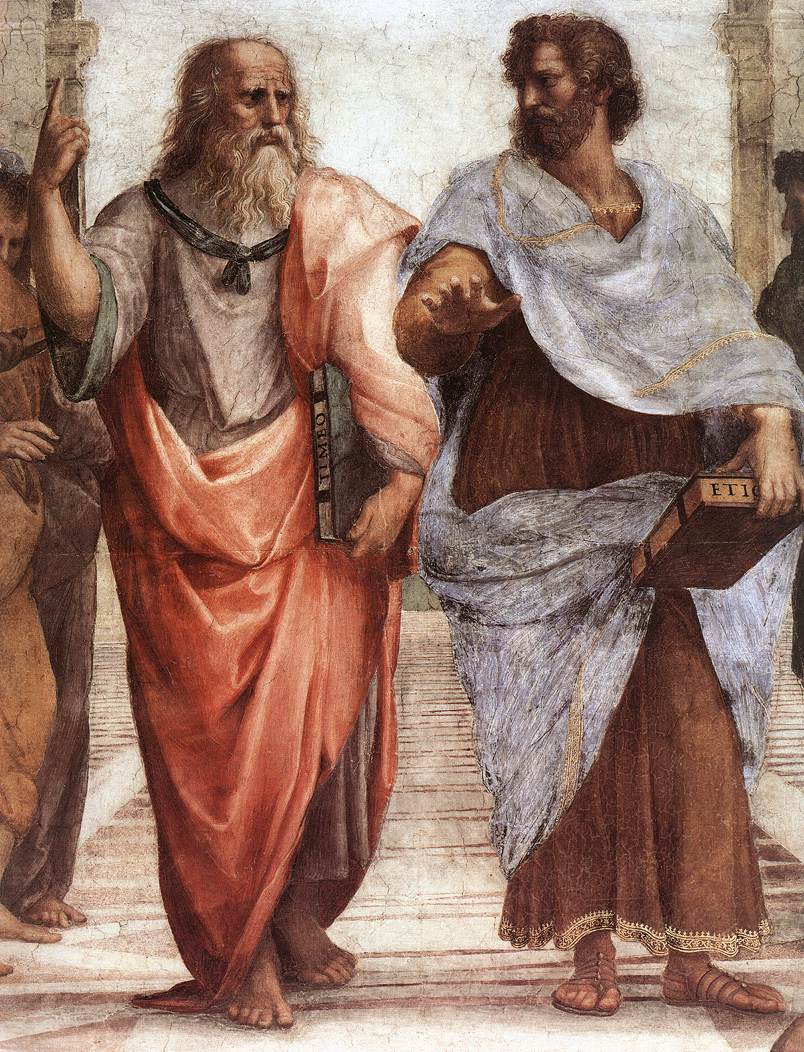
 "The School of Athens"
Raphael (1509)
Earlier this semester as I was teaching Plato's Gorgias, I was reflecting on the way that Socrates pointed out the repeated parallel between genuine goods and their imitations. Of course we see something like this in the Republic, where the shadows are depicted as mere imitations of something much more real. But in the Gorgias, this imitation motiff also applies to certain crafts or skills (τέχνη) as well. The true physical trainer, for example, knows how to make one's body truly healthy. That is the craft or skill he has acquired through study, practice and experience. He requires of those who seek his services discipline with respect to eating, sleeping and exercise. But there is an imitation of this craft that seems to provide us with the very same good, yet without all the work. It gives us the mere appearance of health, but it does not makes us truly healthy. This imitation, in contemporary times, may involve cosmetics, plastic surgery, liposuction, or even anabolic steroids, etc.
Similarly, the nutritionist also has an imitator, one who offers foods that seem good, but in fact are not. Socrates describes these as including meats and sweets and pastries, etc. These foods offered by the imitator even seem to the untrained to be better than the foods the nutritionist advises us to eat, since they are more appealing to the untrained taste. But these foods do not in fact lead to bodily health; they lead to its contrary.
Toward the end of the Gorgias (521d-522a), Socrates shows how the physician would not fare well in a courtroom judged by a jury of children, where the prosecutor is one who practices the 'knack' that imitates the physician's craft. To the children, the physician's practice seems cruel in contrast with the apparent goods offered by the imitator (referred to here as 'pastry-baker' or 'cook'). If you wish to read that particular paragraph click here and do a search within that document for the phrase "I shall be tried just as a physician".
Likewise, according to Plato, the statesman who truly knows the craft of politics knows what is truly good and just for the citizens of the polis (i.e. city). His imitator, on the other hand, appeals to the citizens' [disordered] desires in order to persuade the citizens to choose and support him. He offers to them what seems best to them, but what is not in fact best for them, and may even be harmful to them.
Similarly, the philosopher is the lover of wisdom, truth and justice. But the sophist is the imitator of the philosopher. The sophist has no regard for wisdom, truth and justice, but has a knack (i.e. an imitation of a craft) by which he can persuade his listeners by appealing to what merely seems wise, true and just. In Spe Salvi 6, Pope Benedict makes this distinction between the true philosopher and the charlatan who imitates the true philosopher but does not provide true wisdom. (It should be noted here that the possession of a PhD in philosophy is not a guarantee that the possessor is a true philosopher.)
Similarly, in various places both Plato and Aristotle contrast the friend with the flatterer. The flatterer's knack is the mere imitation of the true friend's activity. The friend aims at bringing about his friend's good. The flatterer, by contrast, ingratiates himself to the other, giving pleasure to him but not aiming to bring about his good. The true friend, by contrast, will say the painful thing that needs to be said for his friend's well being. The flatterer does not do that, precisely because he does not desire the true good of the other person. He says and does things that seem good, but in fact are not truly good, but only superficially pleasing.
These examples all indicate a repeating pattern: a true good, and an imitation that mimics the true good by seeming to offer just what the the true good offers, but in each case offering only the mere appearance of the true good, not the actual true good. Satan cannot offer the true good, for he cannot give what he does not have. So his manner of deceiving must be that of imitating the true good. This is of course why his work culminates in an Antichrist. The term 'Antichrist' does not so much mean someone who is opposed to Christ (although of course he is opposed to Christ), but rather someone who arrogates to himself the place of Christ, as I have discussed previously here. This is Satan's mode of operation. He deceived Eve by offering her an apparent good that in its description seemed to be just what God had offered them as the fruit of obedience. Satan offered them a shortcut to what seemed to be that very same good, i.e. being like God (Gen 3:5), and being immortal ("you shall not die") [Gen 3:4]. Similarly, Satan offered to Jesus what seemed to be His goal, attaining all the kingdoms of the world. But it was by way of a false shortcut, bending the knee to Satan instead of persevering through the cross.
I couldn't help but wonder whether the gospel has an imitation, something that seems to provide everything the true gospel provides, but in fact does not provide the actual good that the true gospel provides. What must this imitation look like?
The imitation gospel is going to offer us what seems like heaven, because the eternal life of heaven is the actual good offered to us in the true gospel. The imitation gospel is going to use the same terms as the actual gospel. That is the most effective way of deceiving people into thinking that what is being talked about is the same thing as what is referred to in the true gospel. That is why knockoff Gucci bags have a 'Gucci' insignia. In order to distinguish the imitation gospel from the real thing, we have to know what we need saving from, in order to know what true salvation is.
I have briefly discussed this before, in my "Gnostic Salvation" paper, and to some degree in my post titled "Prologemona to the Gospel". But I wish to go into a bit more detail here.
The fundamental problem in fallen man is in his heart. Jesus says,
"For out of the heart come evil thoughts, murders, adulteries, fornications, thefts, false witness, slanders." (Matthew 15:19, cf. Mark 7:21, Luke 6:45).
The solution to this heart problem does not involve a mere change of place. If I go on vacation, my heart comes with me. If my heart is evil, then I bring my evil heart with me on vacation. For that reason, in order to go to heaven, I cannot have an evil heart, for if my heart were evil, and heaven were merely a different place than earth, I would bring my evil heart to heaven. And in that case, heaven would not be heaven; it would be merely a continuation of this present world in its fallen condition. No one therefore can enter the eternal life of heaven with an evil heart. The gospel necessarily involves primarily and fundamentally a change of heart, away from the autonomy and self-centered disorientation of pride, and toward God in loving and trusting obedience.
We see this in the transformation of Zaccheus, when he says, "Behold, Lord, half of my possessions I will give to the poor, and if I have defrauded anyone of anything, I will give back four times as much." Jesus says in response, "Today, salvation has come to this house". (St. Luke 19:8-9) Jesus notes that salvation came when Zaccheus had a change of heart. Zaccheus did not first come to understand the 'four spiritual laws' or some kind of formula such as 'justification as imputation by faith alone through grace alone on account of Christ alone'. His heart changed, away from the self-centeredness of sin, toward Christ, in love. This change of heart, according to Jesus, was Zaccheus's salvation.
The solution to the problem of man's sinful heart does not involve simply writing his name in the Book of Life, or balancing his legal account in heaven, insofar as those events are conceived of as external to man. Any proposed solution to the problem of sin that does not change the heart of man does not solve the fundamental problem of man. Pelagianism is a heresy precisely for this reason; it denies the sinfulness of the human heart. But just as a virtue lies between two opposing vices, so the true gospel is opposed not just by the denial of man's sinful heart, but also, on the other side, by any position that merely covers over man's sinful heart. This is the vice that is closer to the virtue, and thus, in a way, more capable of being mistaken for the virtue. (See Nicomachean Ethics 1109a6-12) Any proposed solution to the problem of sin that remains external to the heart, is an imitation of the true gospel, a shortcut to actual salvation.
Here's an example. In a recent conversation on this thread at Michael Spencer's site "Internet Monk", I commented on a brief telephone conversation I had years ago with a Lutheran named Don Matzat. Back in the mid-90s, he was hosting a radio program called "Issues, etc.". So I called in one time, and asked him how there could be anyone in hell, given his Lutheran view of the all-sufficiency of Christ's work and unlimited atonement. Here is his exact answer — I'll never forget it: "All the people in hell are saved; they just don't know it."
Think about that answer for a few moments, and consider the concept of salvation implicit in Matzat's use of the term 'salvation'. According to Matzat, a person can be simultaneously saved and in hell eternally. What follows from that conception of salvation? Salvation, in Matzat's version of the gospel, does not mean loving union with God forever. Otherwise a person could not simultaneously be saved and in hell eternally. Moreover, salvation, in Matzat's version of the gospel does not mean purity of heart. If a person's heart were pure, then there would be no reason for him to be in hell. This shows that in Matzat's version of the gospel, the person who is saved and in hell does not have a pure heart. And this shows that according to Matzat's conception, salvation per se is something *external* to the human heart.
This conception of salvation as something extrinsic to us is entailed by Martin Luther's notion of simul iustus et peccator which I discussed here. Salvation, for Matzat, is (or is primarily) an accounting procedure, not the transformation of an evil heart into a heart filled with the supernatural virtue of charity. As an accounting procedure, salvation is external to us, as if the external problem [i.e. the debt we owe to God on account of our sinfulness] is the fundamental problem, and the internal problem is either secondary or a resultant of the external problem. But the debt of our sin before God has been caused by our sinful hearts. Our sinful hearts are the fundamental problem, and salvation therefore has to be primarily a transformation of the heart from its perversion of curved-inwardness to the rightful order of loving God with all our heart, soul, mind and strength, and, subordinate to that, loving our neighbor as our self.
In Matzat's view, by coming to know that the accounting procedure (in which Christ's merit is applied to our account) has been done for us, for some reason we then get to "go to heaven". There are two things to note about this. First, what effectively translates persons from ending up in hell to ending up in heaven, in Matzat's soteriology, is a bit of knowledge, not the cross or the celestial accounting procedures. And so Matzat's position is in this respect a kind of gnosticism (i.e. salvation by knowledge), even though it is semantically structured such that what gets called 'salvation' is all done by Christ. Contrast that with the Catholic teaching that we are saved not primarily by knowledge of what Christ has done for us, but by becoming a participant in the very life of Christ, in His death and His resurrection, joined to Him through baptism, having His very life within us, even within our hearts. This is how babies are saved through baptism from their original sin, even before they know anything at all.
Second, the conception of heaven implicit in Matzat's statement is primarily one of place. By contrast, Aquinas understands heaven primarily as perfect happiness, the climax of our union with God in charity, i.e. a union of our heart with God's, as the union of two lovers' hearts. According to Aquinas heaven is a partaking of the divine nature (2 Peter 1:4), a kind of participation in the perfect community of the Blessed Trinity. We can have this kind of union with God only if we love Him. The 'placeness' or 'locatedness' of heaven is only secondary, because God, being immaterial, is not in space or time, yet we are embodied and so must be in a place.
Matzat's position has difficulty explaining how it is that saved people with evil hearts who discover that Christ died for them are thereby able to enter heaven, especially if they remain filthy rags merely hidden by a covering. According to his position we remain hidden from God, not open, free and transparent before Him. Matzat's position has difficulty explaining why gaining this bit of knowledge about Christ dying for them makes them suitable to enter heaven. These difficulties arise because this concept of salvation is an imitation of the real thing, for salvation according to this conception does not deal with the primary problem of man's evil heart; it offers a shortcut (i.e. an accounting procedure) by which antinomianism becomes the default, and "sin boldly" becomes even conceivable to utter. No more taking up one's cross. No more "Not everyone who says to Me, 'Lord, Lord,' will enter the kingdom of heaven, but he who does the will of My Father who is in heaven will enter." (Matt 7:21) No more "Depart from me, you who practice lawlessness" (Matt 7:23). No more "We know that no one who is born of God sins" (1 John 5:18).
All of that gets swept under the rug, conceptually excised out of the gospel by an interpretive paradigm that separates all things law-like from all things gospel-ish (i.e pleasant to hear). If this paradigm were applied to friendship, then only flatterers would count as friends; true friends would be considered non-friends. This law-gospel interpretive paradigm is a philosophical presupposition brought to the interpretive process, one whose resulting 'gospel' is an imitation and a shortcut. This interpretive paradigm has difficulty with verses such as St. Paul's description of Christ "dealing out retribution to those who do not know God and to those who do not obey the gospel of our Lord Jesus" (2 Thess 1:8) and St. Peter's question, "what will be the outcome for those who do not obey the gospel of God?" (1 Peter 4:17)
How does this imitation sell itself? By claiming to give God all the glory, and turning that into a theological methodology. This methodology leads to monocausalism, also called monergism. Since Christ should get all the glory, according to this methodology, therefore our salvation cannot at all involve our own will or activity of our will. That same intention to maximize God's glory drove the occasionalists in the Middle Ages to deny actual causal powers to created things, mistakenly thinking that they could ascribe more glory to God by ascribing every effect directly to God as its cause. The occasionlists thereby ended up with a position that runs contrary to the doctrine of creation. In the same way, the methodology of a philosophical theology that seeks to "maximize the glory given to God" presumes dangerously to know what it is, precisely, that maximizes the glory given to God. "We know what will maximize the glory given to God", it reasons; "God must do everything". But this presumptuous and rationalistic approach ends up blinding itself to what salvation actually is, and accepting a cheap substitute, one that doesn't actually save us (and thus, paradoxically, detracts from God's glory).
In Matzat's theology Christ did everything for us except one little (but yet consequentially enormous) thing; He did not believe for us. We still have to believe. But this creates an arbitrariness in rejecting the notion that Christ's work did not include working out my salvation in fear and trembling for me. If Christ's work did not include believing for me, and my believing is an act of the will that contributes to my going to heaven (as Maztat seemingly accepts) then there is no principled reason why my other willings must be excluded from contributing to my going to heaven. If we were truly consistent with this theological methodology of maximizing the glory to God (according to our own conception of what would maximize someone's glory), we would go all the way to universalism, and say that Christ's salvific work does everything for everyone. Already Matzat's position has difficulty explaining why suffering and death, both results of sin, are still around, given that everything needed for our being in heaven (except merely accepting it as true) was already accomplished on the cross by Christ. Matzat's position cannot explain why those of us who know that Christ died for us, are still here. God seems not to have realized that once people came to believe Christ died for them, then since everything had already been accomplished for their going to heaven, there would be nothing left for them to do until they died. We're left just twiddling our thumbs waiting to die or be caught up when Christ returns, whichever comes first. This is monergism’s reductio.
The true gospel as the good news of Christ ultimately transforms us into that which God intended us to be. Made in His image, partakers of His divine nature, we are ennobled and lifted high above all creatures, loved uniquely by God. Walter Farrell O.P., S.T.M. writes:
It would be a poor kind of love that made us in His image and left us nothing to do for ourselves; it is a divine love that sets out a man's work for a man's life and stands by a man's own decisions. He has indeed left us something to do with our mind and our will as well as with our hands and our feet. If we do these things, we are fulfilling the divine will; if we do not, we are not thwarting God but ourselves, for our eternal happiness hangs on the condition of our activity. This is not reason for despair; rather it is a divine tribute to the nobility of the nature of man. If prayer were a cringing, whining, coaxing of a whimsical God, it would debase a man; where, in fact, it is the shouldering of the burden of his own destiny, a doing of his part in winning heaven, it is the ennobling thing that has so set apart the saints from the cowardly braggarts who deify themselves and the whining cowards who dehumanize themselves.
The imitation gospel, by contrast, robs man of meaningfulness and nobility. It makes itself out to be the real gospel. Anyone who disagrees with it is described as having abandoned or compromised the gospel. Anything short of monergism is, by stipulated definition, some species of Pelagianism (see here), and hence some form of heresy. I was reminded of that again when reading of one Talbot graduate student's response to Frank Beckwith's talk there this past Friday evening. The student writes, "I'm not sure whether Beckwith is a brother in Christ, though I lean strongly towards no."
Does the imitation gospel actually harm anyone? Yes, it does. It does so even to those who end up in heaven with God. How so? Because not everyone in heaven is equally happy. Some are more blessed (i.e. happier) than others. Does that mean that some people in heaven are unhappy? No. Everyone in heaven is perfectly happy. Consider a series of cups on a table, each cup is a different size and thus is capable of containing a different volume, and each cup is filled completely to the brim. Are they all perfectly full? Yes. Do they each contain the same amount? No. Some contain more than others. Likewise, in heaven while all souls will be perfectly happy (i.e. filled to the brim with love for God), some hearts will have a greater capacity or disposition to see God, the greater their charity. And our capacity to love God in heaven is related to how we loved Him here on earth. The more we love Him here, the more we will be capable of loving Him in heaven, and thus the happier we will be in heaven eternally. (See Summa Theologica Supp. Q.93 a.3) Thus those whose Christian life here under an imitation gospel consists in reveling in their 'freedom' from good works and construing faith in Christ as meaning that Christ's work on the cross ensures that we do not have to work out our salvation in fear and trembling, are thereby eternally robbed of the level of happiness they could have had, had they lived a righteous and holy life in love for God. It is not enough for Satan to lead people to hell; he seeks also to deprive Christians of the degree of happiness and joy that we will have in heaven.
Not too long ago someone criticized the Catholic teaching concerning the gospel by saying that it detracted from the goodness of the good news, both by requiring that we do good works, and by failing to provide absolute assurance of our elect-to-glory status. Upon hearing this objection I was reminded of the 'pastry-baker' in Plato's Gorgias accusing the physician before the children: "His message detracts from the goodness of the good news that I'm giving you; you don't need to exercise regularly or avoid pastries, sugar and fat." What is it but sophistry that measures the truth of any version of the gospel by how 'good' it appears to us? That's simply another form of ecclesial consumerism. According to this maxim, the more 'freeing' and antinomian one's version of the gospel, the more it must be true, since then it is 'better' news, and the gospel [εὐαγγέλιον] is "good news". This kind of thinking is what makes so many people susceptible to the Heath and Wealth 'gospel' offered by well-known figures such as Benny Hinn and Kenneth Copeland. The better the offer, the more it must be the gospel, because 'gospel' means good news.
But that way of thinking is deeply flawed, precisely because what seems good to us is not necessarily what is actually good for us, just as what seems good to the jury of children in Plato's Gorgias is not in fact what is good for them. The goodness of the good news depends upon its truth. If the 'good news' is false, then it is not good news, no matter how good it sounds or seems. Therefore we should not compare versions of the gospel by how good they seem to us, but rather by which is true, even if it seems less attractive and more arduous than the other versions of the gospel.
Satan's greatest deception is convincing people that they do not need to be saved. His most effective way of doing this is to convince them that they are already entirely saved when in fact they are not. And his most effective way of doing this is to convince them that salvation is something external to them, something already entirely accomplished for them outside of them, and not requiring love and righteousness in their heart or obedience in their lives. In this way, they think they do not need salvation, because they think they are already saved, as saved as they can possibly be this side of heaven. What they have, however, is an imitation of the gospel, and this inoculates them to the true gospel. The imitation gospel allows them to ignore their sinful heart, and even celebrate it by recharacterizing it as 'freedom' from the law. They have been deceived by accepting a cheap knockoff conception of heaven as merely a nice place, and not as an everlasting loving and obedient union of our hearts with the heart of God. If they understood heaven to be most fundamentally a union of hearts (ours with God), they would understand that the gospel must be a purification of our heart, for light can have no fellowship with darkness. (2 Corinthians 6:14)
The true gospel "cleanses our hearts by faith" (Acts 15:9). The true gospel gives us a pure heart (1 Timothy 1:5; Romans 2:29). Otherwise St. Paul could not have written, "Now flee from youthful lusts and pursue righteousness, faith, love and peace, with those who call on the Lord from a pure heart." (2 Timothy 2:22) He could not have written that because there would have been no one with a pure heart with whom to call on the Lord. But they had, by the grace of Christ, purified their hearts, as St. James commands that we do. (St. James 4:8) Their hearts had been filled with the love of God, as St. Paul writes, saying, that the "love of God has been poured out within our hearts through the Holy Spirit who was given to us". (Romans 5:5) When Jesus said that the good man out of the good treasure of his heart brings forth what is good (St. Luke 6:45), He wasn't speaking about a merely hypothetical, someone not to exist this side of heaven. He was talking about what His own followers are to be now, through His grace. His command to be perfect, as our Father in heaven is perfect, was not a mere hypothetical (St. Matthew 5:48). This is what He truly wants His followers to be, now, and He has provided the means for us to attain this goal through the grace that comes to us through the sacraments.
"Blessed are the pure in heart, for they shall see God." (St. Matthew 5:8)
The ultimate goal of the true gospel is to see God. And in order to see Him, we must be pure in heart. The imitations reduce the gospel, either to a denial of our sinful heart, or to a covering of our hearts, a perpetuation of the fig leaves in the Garden of Eden. The true gospel, and it alone, provides the means by which our sinful hearts may be purified so that we attain true salvation, eternal union with God our loving Father.
Lord Jesus, please help us all come to unity in the true gospel that you entrusted to your Apostles. In the name of the Father, and of the Son, and of the Holy Spirit. Amen.




 Posts
Posts

