"Let unity, the greatest good of all goods, be your preoccupation." - St. Ignatius of Antioch (Letter to St. Polycarp)

Monday, November 3, 2008

On Imitations and the Gospel


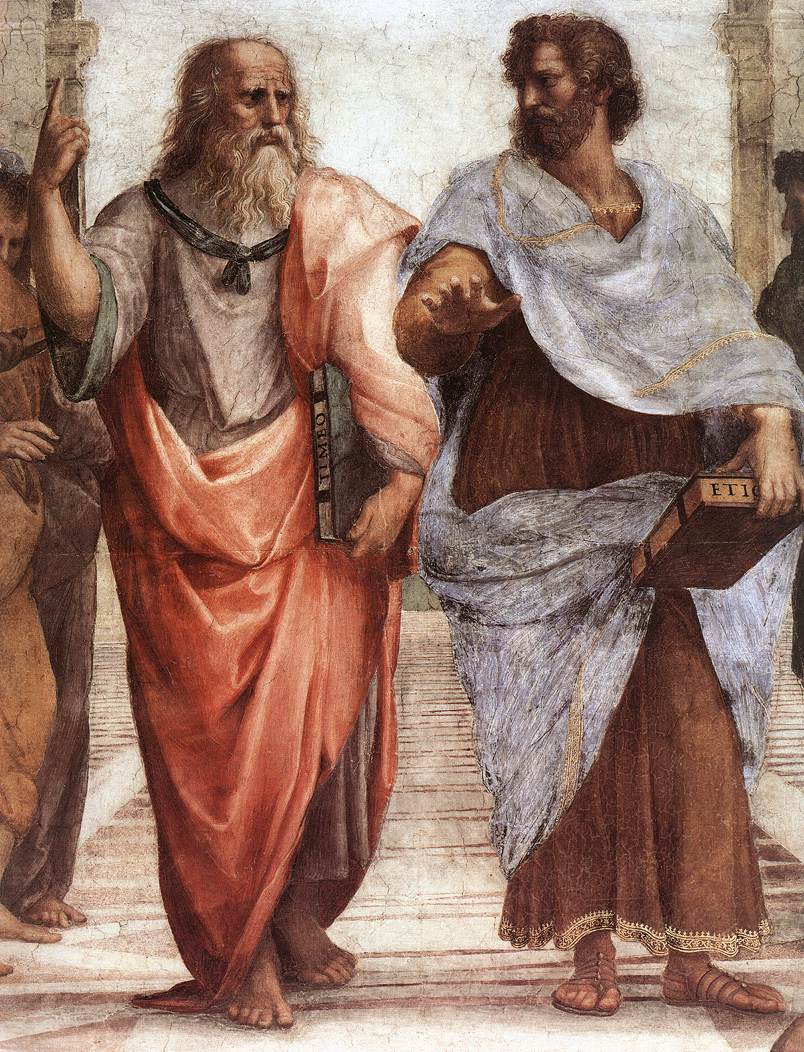
"The School of Athens"
Raphael (1509)

Earlier this semester as I was teaching Plato's Gorgias, I was reflecting on the way that Socrates pointed out the repeated parallel between genuine goods and their imitations. Of course we see something like this in the Republic, where the shadows are depicted as mere imitations of something much more real. But in the Gorgias, this imitation motiff also applies to certain crafts or skills (τέχνη) as well. The true physical trainer, for example, knows how to make one's body truly healthy. That is the craft or skill he has acquired through study, practice and experience. He requires of those who seek his services discipline with respect to eating, sleeping and exercise. But there is an imitation of this craft that seems to provide us with the very same good, yet without all the work. It gives us the mere appearance of health, but it does not makes us truly healthy. This imitation, in contemporary times, may involve cosmetics, plastic surgery, liposuction, or even anabolic steroids, etc.

Similarly, the nutritionist also has an imitator, one who offers foods that seem good, but in fact are not. Socrates describes these as including meats and sweets and pastries, etc. These foods offered by the imitator even seem to the untrained to be better than the foods the nutritionist advises us to eat, since they are more appealing to the untrained taste. But these foods do not in fact lead to bodily health; they lead to its contrary.

Toward the end of the Gorgias (521d-522a), Socrates shows how the physician would not fare well in a courtroom judged by a jury of children, where the prosecutor is one who practices the 'knack' that imitates the physician's craft. To the children, the physician's practice seems cruel in contrast with the apparent goods offered by the imitator (referred to here as 'pastry-baker' or 'cook'). If you wish to read that particular paragraph click here and do a search within that document for the phrase "I shall be tried just as a physician".

Likewise, according to Plato, the statesman who truly knows the craft of politics knows what is truly good and just for the citizens of the polis (i.e. city). His imitator, on the other hand, appeals to the citizens' [disordered] desires in order to persuade the citizens to choose and support him. He offers to them what seems best to them, but what is not in fact best for them, and may even be harmful to them.

Similarly, the philosopher is the lover of wisdom, truth and justice. But the sophist is the imitator of the philosopher. The sophist has no regard for wisdom, truth and justice, but has a knack (i.e. an imitation of a craft) by which he can persuade his listeners by appealing to what merely seems wise, true and just. In Spe Salvi 6, Pope Benedict makes this distinction between the true philosopher and the charlatan who imitates the true philosopher but does not provide true wisdom. (It should be noted here that the possession of a PhD in philosophy is not a guarantee that the possessor is a true philosopher.)

Similarly, in various places both Plato and Aristotle contrast the friend with the flatterer. The flatterer's knack is the mere imitation of the true friend's activity. The friend aims at bringing about his friend's good. The flatterer, by contrast, ingratiates himself to the other, giving pleasure to him but not aiming to bring about his good. The true friend, by contrast, will say the painful thing that needs to be said for his friend's well being. The flatterer does not do that, precisely because he does not desire the true good of the other person. He says and does things that seem good, but in fact are not truly good, but only superficially pleasing.

These examples all indicate a repeating pattern: a true good, and an imitation that mimics the true good by seeming to offer just what the the true good offers, but in each case offering only the mere appearance of the true good, not the actual true good. Satan cannot offer the true good, for he cannot give what he does not have. So his manner of deceiving must be that of imitating the true good. This is of course why his work culminates in an Antichrist. The term 'Antichrist' does not so much mean someone who is opposed to Christ (although of course he is opposed to Christ), but rather someone who arrogates to himself the place of Christ, as I have discussed previously here. This is Satan's mode of operation. He deceived Eve by offering her an apparent good that in its description seemed to be just what God had offered them as the fruit of obedience. Satan offered them a shortcut to what seemed to be that very same good, i.e. being like God (Gen 3:5), and being immortal ("you shall not die") [Gen 3:4]. Similarly, Satan offered to Jesus what seemed to be His goal, attaining all the kingdoms of the world. But it was by way of a false shortcut, bending the knee to Satan instead of persevering through the cross.

I couldn't help but wonder whether the gospel has an imitation, something that seems to provide everything the true gospel provides, but in fact does not provide the actual good that the true gospel provides. What must this imitation look like?

The imitation gospel is going to offer us what seems like heaven, because the eternal life of heaven is the actual good offered to us in the true gospel. The imitation gospel is going to use the same terms as the actual gospel. That is the most effective way of deceiving people into thinking that what is being talked about is the same thing as what is referred to in the true gospel. That is why knockoff Gucci bags have a 'Gucci' insignia. In order to distinguish the imitation gospel from the real thing, we have to know what we need saving from, in order to know what true salvation is.

I have briefly discussed this before, in my "Gnostic Salvation" paper, and to some degree in my post titled "Prologemona to the Gospel". But I wish to go into a bit more detail here.

The fundamental problem in fallen man is in his heart. Jesus says,

"For out of the heart come evil thoughts, murders, adulteries, fornications, thefts, false witness, slanders." (Matthew 15:19, cf. Mark 7:21, Luke 6:45).

The solution to this heart problem does not involve a mere change of place. If I go on vacation, my heart comes with me. If my heart is evil, then I bring my evil heart with me on vacation. For that reason, in order to go to heaven, I cannot have an evil heart, for if my heart were evil, and heaven were merely a different place than earth, I would bring my evil heart to heaven. And in that case, heaven would not be heaven; it would be merely a continuation of this present world in its fallen condition. No one therefore can enter the eternal life of heaven with an evil heart. The gospel necessarily involves primarily and fundamentally a change of heart, away from the autonomy and self-centered disorientation of pride, and toward God in loving and trusting obedience.

We see this in the transformation of Zaccheus, when he says, "Behold, Lord, half of my possessions I will give to the poor, and if I have defrauded anyone of anything, I will give back four times as much." Jesus says in response, "Today, salvation has come to this house". (St. Luke 19:8-9) Jesus notes that salvation came when Zaccheus had a change of heart. Zaccheus did not first come to understand the 'four spiritual laws' or some kind of formula such as 'justification as imputation by faith alone through grace alone on account of Christ alone'. His heart changed, away from the self-centeredness of sin, toward Christ, in love. This change of heart, according to Jesus, was Zaccheus's salvation.

The solution to the problem of man's sinful heart does not involve simply writing his name in the Book of Life, or balancing his legal account in heaven, insofar as those events are conceived of as external to man. Any proposed solution to the problem of sin that does not change the heart of man does not solve the fundamental problem of man. Pelagianism is a heresy precisely for this reason; it denies the sinfulness of the human heart. But just as a virtue lies between two opposing vices, so the true gospel is opposed not just by the denial of man's sinful heart, but also, on the other side, by any position that merely covers over man's sinful heart. This is the vice that is closer to the virtue, and thus, in a way, more capable of being mistaken for the virtue. (See Nicomachean Ethics 1109a6-12) Any proposed solution to the problem of sin that remains external to the heart, is an imitation of the true gospel, a shortcut to actual salvation.

Here's an example. In a recent conversation on this thread at Michael Spencer's site "Internet Monk", I commented on a brief telephone conversation I had years ago with a Lutheran named Don Matzat. Back in the mid-90s, he was hosting a radio program called "Issues, etc.". So I called in one time, and asked him how there could be anyone in hell, given his Lutheran view of the all-sufficiency of Christ's work and unlimited atonement. Here is his exact answer — I'll never forget it: "All the people in hell are saved; they just don't know it."

Think about that answer for a few moments, and consider the concept of salvation implicit in Matzat's use of the term 'salvation'. According to Matzat, a person can be simultaneously saved and in hell eternally. What follows from that conception of salvation? Salvation, in Matzat's version of the gospel, does not mean loving union with God forever. Otherwise a person could not simultaneously be saved and in hell eternally. Moreover, salvation, in Matzat's version of the gospel does not mean purity of heart. If a person's heart were pure, then there would be no reason for him to be in hell. This shows that in Matzat's version of the gospel, the person who is saved and in hell does not have a pure heart. And this shows that according to Matzat's conception, salvation per se is something *external* to the human heart.

This conception of salvation as something extrinsic to us is entailed by Martin Luther's notion of simul iustus et peccator which I discussed here. Salvation, for Matzat, is (or is primarily) an accounting procedure, not the transformation of an evil heart into a heart filled with the supernatural virtue of charity. As an accounting procedure, salvation is external to us, as if the external problem [i.e. the debt we owe to God on account of our sinfulness] is the fundamental problem, and the internal problem is either secondary or a resultant of the external problem. But the debt of our sin before God has been caused by our sinful hearts. Our sinful hearts are the fundamental problem, and salvation therefore has to be primarily a transformation of the heart from its perversion of curved-inwardness to the rightful order of loving God with all our heart, soul, mind and strength, and, subordinate to that, loving our neighbor as our self.

In Matzat's view, by coming to know that the accounting procedure (in which Christ's merit is applied to our account) has been done for us, for some reason we then get to "go to heaven". There are two things to note about this. First, what effectively translates persons from ending up in hell to ending up in heaven, in Matzat's soteriology, is a bit of knowledge, not the cross or the celestial accounting procedures. And so Matzat's position is in this respect a kind of gnosticism (i.e. salvation by knowledge), even though it is semantically structured such that what gets called 'salvation' is all done by Christ. Contrast that with the Catholic teaching that we are saved not primarily by knowledge of what Christ has done for us, but by becoming a participant in the very life of Christ, in His death and His resurrection, joined to Him through baptism, having His very life within us, even within our hearts. This is how babies are saved through baptism from their original sin, even before they know anything at all.

Second, the conception of heaven implicit in Matzat's statement is primarily one of place. By contrast, Aquinas understands heaven primarily as perfect happiness, the climax of our union with God in charity, i.e. a union of our heart with God's, as the union of two lovers' hearts. According to Aquinas heaven is a partaking of the divine nature (2 Peter 1:4), a kind of participation in the perfect community of the Blessed Trinity. We can have this kind of union with God only if we love Him. The 'placeness' or 'locatedness' of heaven is only secondary, because God, being immaterial, is not in space or time, yet we are embodied and so must be in a place.

Matzat's position has difficulty explaining how it is that saved people with evil hearts who discover that Christ died for them are thereby able to enter heaven, especially if they remain filthy rags merely hidden by a covering. According to his position we remain hidden from God, not open, free and transparent before Him. Matzat's position has difficulty explaining why gaining this bit of knowledge about Christ dying for them makes them suitable to enter heaven. These difficulties arise because this concept of salvation is an imitation of the real thing, for salvation according to this conception does not deal with the primary problem of man's evil heart; it offers a shortcut (i.e. an accounting procedure) by which antinomianism becomes the default, and "sin boldly" becomes even conceivable to utter. No more taking up one's cross. No more "Not everyone who says to Me, 'Lord, Lord,' will enter the kingdom of heaven, but he who does the will of My Father who is in heaven will enter." (Matt 7:21) No more "Depart from me, you who practice lawlessness" (Matt 7:23). No more "We know that no one who is born of God sins" (1 John 5:18).

All of that gets swept under the rug, conceptually excised out of the gospel by an interpretive paradigm that separates all things law-like from all things gospel-ish (i.e pleasant to hear). If this paradigm were applied to friendship, then only flatterers would count as friends; true friends would be considered non-friends. This law-gospel interpretive paradigm is a philosophical presupposition brought to the interpretive process, one whose resulting 'gospel' is an imitation and a shortcut. This interpretive paradigm has difficulty with verses such as St. Paul's description of Christ "dealing out retribution to those who do not know God and to those who do not obey the gospel of our Lord Jesus" (2 Thess 1:8) and St. Peter's question, "what will be the outcome for those who do not obey the gospel of God?" (1 Peter 4:17)

How does this imitation sell itself? By claiming to give God all the glory, and turning that into a theological methodology. This methodology leads to monocausalism, also called monergism. Since Christ should get all the glory, according to this methodology, therefore our salvation cannot at all involve our own will or activity of our will. That same intention to maximize God's glory drove the occasionalists in the Middle Ages to deny actual causal powers to created things, mistakenly thinking that they could ascribe more glory to God by ascribing every effect directly to God as its cause. The occasionlists thereby ended up with a position that runs contrary to the doctrine of creation. In the same way, the methodology of a philosophical theology that seeks to "maximize the glory given to God" presumes dangerously to know what it is, precisely, that maximizes the glory given to God. "We know what will maximize the glory given to God", it reasons; "God must do everything". But this presumptuous and rationalistic approach ends up blinding itself to what salvation actually is, and accepting a cheap substitute, one that doesn't actually save us (and thus, paradoxically, detracts from God's glory).

In Matzat's theology Christ did everything for us except one little (but yet consequentially enormous) thing; He did not believe for us. We still have to believe. But this creates an arbitrariness in rejecting the notion that Christ's work did not include working out my salvation in fear and trembling for me. If Christ's work did not include believing for me, and my believing is an act of the will that contributes to my going to heaven (as Maztat seemingly accepts) then there is no principled reason why my other willings must be excluded from contributing to my going to heaven. If we were truly consistent with this theological methodology of maximizing the glory to God (according to our own conception of what would maximize someone's glory), we would go all the way to universalism, and say that Christ's salvific work does everything for everyone. Already Matzat's position has difficulty explaining why suffering and death, both results of sin, are still around, given that everything needed for our being in heaven (except merely accepting it as true) was already accomplished on the cross by Christ. Matzat's position cannot explain why those of us who know that Christ died for us, are still here. God seems not to have realized that once people came to believe Christ died for them, then since everything had already been accomplished for their going to heaven, there would be nothing left for them to do until they died. We're left just twiddling our thumbs waiting to die or be caught up when Christ returns, whichever comes first. This is monergism’s reductio.

The true gospel as the good news of Christ ultimately transforms us into that which God intended us to be. Made in His image, partakers of His divine nature, we are ennobled and lifted high above all creatures, loved uniquely by God. Walter Farrell O.P., S.T.M. writes:

It would be a poor kind of love that made us in His image and left us nothing to do for ourselves; it is a divine love that sets out a man's work for a man's life and stands by a man's own decisions. He has indeed left us something to do with our mind and our will as well as with our hands and our feet. If we do these things, we are fulfilling the divine will; if we do not, we are not thwarting God but ourselves, for our eternal happiness hangs on the condition of our activity. This is not reason for despair; rather it is a divine tribute to the nobility of the nature of man. If prayer were a cringing, whining, coaxing of a whimsical God, it would debase a man; where, in fact, it is the shouldering of the burden of his own destiny, a doing of his part in winning heaven, it is the ennobling thing that has so set apart the saints from the cowardly braggarts who deify themselves and the whining cowards who dehumanize themselves.

The imitation gospel, by contrast, robs man of meaningfulness and nobility. It makes itself out to be the real gospel. Anyone who disagrees with it is described as having abandoned or compromised the gospel. Anything short of monergism is, by stipulated definition, some species of Pelagianism (see here), and hence some form of heresy. I was reminded of that again when reading of one Talbot graduate student's response to Frank Beckwith's talk there this past Friday evening. The student writes, "I'm not sure whether Beckwith is a brother in Christ, though I lean strongly towards no."

Does the imitation gospel actually harm anyone? Yes, it does. It does so even to those who end up in heaven with God. How so? Because not everyone in heaven is equally happy. Some are more blessed (i.e. happier) than others. Does that mean that some people in heaven are unhappy? No. Everyone in heaven is perfectly happy. Consider a series of cups on a table, each cup is a different size and thus is capable of containing a different volume, and each cup is filled completely to the brim. Are they all perfectly full? Yes. Do they each contain the same amount? No. Some contain more than others. Likewise, in heaven while all souls will be perfectly happy (i.e. filled to the brim with love for God), some hearts will have a greater capacity or disposition to see God, the greater their charity. And our capacity to love God in heaven is related to how we loved Him here on earth. The more we love Him here, the more we will be capable of loving Him in heaven, and thus the happier we will be in heaven eternally. (See Summa Theologica Supp. Q.93 a.3) Thus those whose Christian life here under an imitation gospel consists in reveling in their 'freedom' from good works and construing faith in Christ as meaning that Christ's work on the cross ensures that we do not have to work out our salvation in fear and trembling, are thereby eternally robbed of the level of happiness they could have had, had they lived a righteous and holy life in love for God. It is not enough for Satan to lead people to hell; he seeks also to deprive Christians of the degree of happiness and joy that we will have in heaven.

Not too long ago someone criticized the Catholic teaching concerning the gospel by saying that it detracted from the goodness of the good news, both by requiring that we do good works, and by failing to provide absolute assurance of our elect-to-glory status. Upon hearing this objection I was reminded of the 'pastry-baker' in Plato's Gorgias accusing the physician before the children: "His message detracts from the goodness of the good news that I'm giving you; you don't need to exercise regularly or avoid pastries, sugar and fat." What is it but sophistry that measures the truth of any version of the gospel by how 'good' it appears to us? That's simply another form of ecclesial consumerism. According to this maxim, the more 'freeing' and antinomian one's version of the gospel, the more it must be true, since then it is 'better' news, and the gospel [εὐαγγέλιον] is "good news". This kind of thinking is what makes so many people susceptible to the Heath and Wealth 'gospel' offered by well-known figures such as Benny Hinn and Kenneth Copeland. The better the offer, the more it must be the gospel, because 'gospel' means good news.

But that way of thinking is deeply flawed, precisely because what seems good to us is not necessarily what is actually good for us, just as what seems good to the jury of children in Plato's Gorgias is not in fact what is good for them. The goodness of the good news depends upon its truth. If the 'good news' is false, then it is not good news, no matter how good it sounds or seems. Therefore we should not compare versions of the gospel by how good they seem to us, but rather by which is true, even if it seems less attractive and more arduous than the other versions of the gospel.

Satan's greatest deception is convincing people that they do not need to be saved. His most effective way of doing this is to convince them that they are already entirely saved when in fact they are not. And his most effective way of doing this is to convince them that salvation is something external to them, something already entirely accomplished for them outside of them, and not requiring love and righteousness in their heart or obedience in their lives. In this way, they think they do not need salvation, because they think they are already saved, as saved as they can possibly be this side of heaven. What they have, however, is an imitation of the gospel, and this inoculates them to the true gospel. The imitation gospel allows them to ignore their sinful heart, and even celebrate it by recharacterizing it as 'freedom' from the law. They have been deceived by accepting a cheap knockoff conception of heaven as merely a nice place, and not as an everlasting loving and obedient union of our hearts with the heart of God. If they understood heaven to be most fundamentally a union of hearts (ours with God), they would understand that the gospel must be a purification of our heart, for light can have no fellowship with darkness. (2 Corinthians 6:14)

The true gospel "cleanses our hearts by faith" (Acts 15:9). The true gospel gives us a pure heart (1 Timothy 1:5; Romans 2:29). Otherwise St. Paul could not have written, "Now flee from youthful lusts and pursue righteousness, faith, love and peace, with those who call on the Lord from a pure heart." (2 Timothy 2:22) He could not have written that because there would have been no one with a pure heart with whom to call on the Lord. But they had, by the grace of Christ, purified their hearts, as St. James commands that we do. (St. James 4:8) Their hearts had been filled with the love of God, as St. Paul writes, saying, that the "love of God has been poured out within our hearts through the Holy Spirit who was given to us". (Romans 5:5) When Jesus said that the good man out of the good treasure of his heart brings forth what is good (St. Luke 6:45), He wasn't speaking about a merely hypothetical, someone not to exist this side of heaven. He was talking about what His own followers are to be now, through His grace. His command to be perfect, as our Father in heaven is perfect, was not a mere hypothetical (St. Matthew 5:48). This is what He truly wants His followers to be, now, and He has provided the means for us to attain this goal through the grace that comes to us through the sacraments.

"Blessed are the pure in heart, for they shall see God." (St. Matthew 5:8)

The ultimate goal of the true gospel is to see God. And in order to see Him, we must be pure in heart. The imitations reduce the gospel, either to a denial of our sinful heart, or to a covering of our hearts, a perpetuation of the fig leaves in the Garden of Eden. The true gospel, and it alone, provides the means by which our sinful hearts may be purified so that we attain true salvation, eternal union with God our loving Father.

Lord Jesus, please help us all come to unity in the true gospel that you entrusted to your Apostles. In the name of the Father, and of the Son, and of the Holy Spirit. Amen.

Wednesday, October 29, 2008

"the babies of the world will just have to wait"


"the babies of the world will just have to wait"

That is a line I came across recently, from a Christian dismissing the abortion issue in relation to this year's US presidential election.

Every year about 1,300,000 babies are aborted in the US. That's 5,200,000 babies over the next four years that won't get to "wait" -- they will be killed. The common reply is that neither candidate will make a difference with respect to the number of abortions. But that is simply not true. Obama promised a group of prominent abortion advocates that his "very first" act as President would be to sign the Freedom of Choice Act [FOCA] into law. [watch the video] The passing of FOCA would result in approximately 125,000 more abortions per year. [source]. Given that, how could any Christian justifiably vote for Obama? What good could Obama possibly bring as President that would justify the killing of an additional 125,000 babies per year?

To conceive this more clearly, imagine that if Obama were to win, 125,000 babies per year would be sacrificed publicly on an altar on the White House lawn. That's a rate of 342 babies killed per day, or 14 babies killed per hour, or one baby killed about every 4 minutes. Imagine that every 4 minutes during an Obama administration, for the next four years, a baby is killed on this altar. Are the promised benefits of an Obama administration worth killing a baby every 4 minutes around the clock, 24/7, for the next four years?

Even in purely utilitarian terms, if we set aside the intrinsic injustice of killing innocent persons, it is difficult to imagine any comparable, let alone outweighing, good that could possibly justify killing a baby every 4 minutes for the next four years. Therefore, there seems to be no moral justification for voting for Obama. Obama supporters must either (1) not be aware of the implications of FOCA, or (2) not be aware that abortion is the killing of an innocent human being (see here), or (3) think that the good that Obama would do as President would be worth killing a baby every four minutes for the next four years.

Bishop Finn of Kansas put it this way:

"[I]f we are inclined to vote for someone despite their pro-abortion stance, it seems we are morally obliged to establish a proportionate reason sufficient to justify the destruction of 45 million human persons through abortion. If we learn that our "candidate of choice" further pledges – through an instrument such as FOCA - to eliminate all existing limitations against abortion, it is that much more doubtful whether voting for him or her can ever be morally justified under any circumstance." (source)

Bishop Hermann of the Archdiocese of St. Louis had this to say: "More than anything else, this election is about saving our children or killing our children."

Cardinal Egan of New York says this: "[H]ave you any doubt that the authorities in a civilized society are duty-bound to protect this innocent human being if anyone were to wish to kill it?"

Bishop Farrell of Dallas and Bishop Vann of Fort Worth issued a Joint Statement on this subject. Here's an excerpt:

The only moral possibilities for a Catholic to be able to vote in good conscience for a candidate who supports this intrinsic evil are the following:

a. If both candidates running for office support abortion or "abortion rights," a Catholic would be forced to then look at the other important issues and through their vote try to limit the evil done; or,

b. If another intrinsic evil outweighs the evil of abortion. While this is sound moral reasoning, there are no "truly grave moral" or “proportionate” reasons, singularly or combined, that could outweigh the millions of innocent human lives that are directly killed by legal abortion each year.
To vote for a candidate who supports the intrinsic evil of abortion or "abortion rights" when there is a morally acceptable alternative would be to cooperate in the evil – and, therefore, morally impermissible.

Over one hundred US Catholic bishops have spoken out similarly. (source) Why is this issue so important? It is not only the saving of the lives of these 125,000 children per year. As I explained in my previous post on this subject titled "Finding Unity in Morality", all our rights depend on the right to life. "Without the right to life, no other right can be defended." (Fr. Zuhlsdorf).

Many of us have been working to protect unborn children for many years. Part of the fruit of that work has been the appointment of several Supreme Court justices who understand that the Constitution does not give anyone a right to kill unborn children. McCain said this: "I will look for people in the cast of John Roberts, Samuel Alito, and my friend the late William Rehnquist -- jurists of the highest caliber who know their own minds, and know the law, and know the difference". Obama, as Princeton Professor Robert George has succinctly argued here, has clearly demonstrated himself to be the most pro-abortion candidate this nation has ever known, explicitly ensuring he would select Supreme Court justices who retain Roe vs. Wade. We've worked too hard to get this close to overturning Roe vs. Wade. Now is not the time to slacken our effort. Obama is right on this point, that in this election, Roe vs. Wade "probably hangs in the balance". (source)

When I was growing up, I thought that the only way to change a society's moral consciousness was through religious conversion. Of course I understood that we needed laws, but I believed that laws merely prevented anarchy; in my mind, they definitely didn't change hearts. That is why I thought efforts to change our country by way of political means were a misguided waste of time. But later I came to see that my gnosticism had prevented me from seeing that it is not either/or, but both/and. Plato explains both in his Republic and in his Laws, that the laws of a society shape and train its citizens in their dispositions to act, their appetites, and in their conceptions of right and wrong. As parents by their discipline shape and form the moral habits and appetites of their children, so likewise do the laws of a nation shape the moral habits and appetites of its people. We change our society both by directly influencing the hearts and minds of our neighbors, and by selecting leaders who will enact and enforce a body of law that will also shape the moral habits and conscience of all citizens. It is not an either/or, but necessarily a both/and. We must not fail in our civic duty, by falsely assuming that society is changed and formed only by our conversations and relationships with our neighbors. Our neighbors' morals are also affected by how we vote, because the laws and policies enacted by political leaders shape and form the moral consciousness of a nation's citizens. And the laws that in recent years have been put in place to restrict abortion are making a difference.

Some people I talk with think that the government should not "legislate morality". They do not seem to understand that the government of any people has a necessary duty to protect and defend innocent human life, whether already born or not yet born. The obligation to protect innocent human life is not just a Christian obligation, but is known to reason and knowable by reason. (cf. Declaration on Procured Abortion, 8) Consider this selection from (Evangelium vitae, 71).

The real purpose of civil law is to guarantee an ordered social coexistence in true justice, so that all may "lead a quiet and peaceable life, godly and respectful in every way" (1 Tim 2:2). Precisely for this reason, civil law must ensure that all members of society enjoy respect for certain fundamental rights which innately belong to the person, rights which every positive law must recognize and guarantee. First and fundamental among these is the inviolable right to life of every innocent human being. While public authority can sometimes choose not to put a stop to something which-were it prohibited- would cause more serious harm, it can never presume to legitimize as a right of individuals-even if they are the majority of the members of society-an offence against other persons caused by the disregard of so fundamental a right as the right to life. The legal toleration of abortion or of euthanasia can in no way claim to be based on respect for the conscience of others, precisely because society has the right and the duty to protect itself against the abuses which can occur in the name of conscience and under the pretext of freedom.

May we not be known as the generation who decided that the "babies of the world will just have to wait". May their blood not be on our hands. Please do whatever is in your power to spread the word to everyone you know; the lives of 125,000 children a year depend on what we do right now. We are also praying a novena until next Tuesday; please pray hard. But don't just pray - pray and pass on the truth. We are our brother's keeper, even of those in the womb. They cannot speak on their own behalf; if we don't stand up for them and defend them, who will?

"Lord Jesus Christ, You told us to give to Caesar what belongs to Caesar, and to God what belongs to God. Enlighten the minds of our people [in] America. May we choose a President of the United States, and other government officials, according to Your Divine Will. Give our citizens the courage to choose leaders of our nation who respect the sanctity of unborn human life, the sanctity of marriage, the sanctity of marital relations, the sanctity of the family, and the sanctity of the aging. Grant us the wisdom to give You, what belongs to You, our God. If we do this, as a nation, we are confident You will give us an abundance of Your blessings through our elected leaders. Amen." [Fr. Hardon]

Tuesday, October 28, 2008

Patriarch's Impact at the Synod

Archimandrite Ignatios Sotiriadis
Zenit has an interesting interview with Archimandrite Ignatios Sotiriadis about the participation of Patriarch Bartholomew I in the recent Synod of Catholic Bishops. Here's a selection (my emphases in bold):

Archimandrite Ignatios: First of all, I feel proud to see His Holiness Ecumenical Patriarch Bartholomew I in the Sistine Chapel, where popes are elected, also famous worldwide for its artistic value, because I consider the invitation from Pope Benedict to the "primus inter pares" of the Orthodox Church a most great honor. ...

It was a historical event, in which a Pope celebrates vespers before the representatives of the entire Catholic episcopate and on this occasion, doesn't exercise his ministry as teacher, but concedes it to the second bishop of the Church when it was not yet divided.

What most impressed me was what the Pope said when the patriarch's homily, received with long applause, was over: "If we have common fathers, how can we not be brothers?" ....

Q: But the great novelty, perhaps, has not been the patriarch's intervention, but rather the desire of the Pope, expressed at the end of vespers, to include the patriarch's proposals in the synodal proposals. This is an initiative that appears to have been welcomed by the synod fathers. In this way, for the first time in history, the magisterium of an ecumenical patriarch could be taken up by the official magisterium of the Catholic Church in the postsynodal apostolic exhortation.

Archimandrite Ignatios: When we are united in the Word of God, our path inevitably leads us toward a second stage, which is full unity, that is, a common celebration of the Eucharist. But this will not be reached as much with human efforts as with the breath and will of the Holy Spirit.

Q: Yet those who hope for this unity sometimes see it as something far off …

Archimandrite Ignatios: The separation of the Eastern and Western Church occurred over various centuries; it was not an isolated event in the year 1054, but a long cultural, linguistic process. … I think that the re-encounter will happen in the same way, following a gradual path. We separated slowly, and slowly we will unite. But it is not for us to talk of dates.

What is certain is the desire of the Orthodox Church that the Church of Rome parts with its temporal power and dedicates itself totally to its spiritual mission for the transformation of the world.

[My original post on this event, as well as the Patriarch's address to the Synod, can be found here. Please continue to pray daily for the full visible unity of all Christians.]

Monday, October 27, 2008

"That they may be one, just as We are one"


The Cestello Annunciation
Sandro Botticelli (1489)

I just returned from the annual American Maritain Association conference, which was held in Boston this year. This year's conference was excellent. And Boston is beautiful this time of year, as all the trees are in their prime. At this conference I was especially impressed by the papers given by Dr. Lawrence Feingold, a convert to Catholicism in 1989, currently teaching for Ave Maria University's Institute for Pastoral Studies. His dissertation The Natural Desire to See God According to St. Thomas Aquinas and His Interpreters is being published by Sapientia Press, I believe.

What is the significance of the Annunciation? It is the moment of the incarnation, when Christ takes on human nature, and becomes man, with a human body and a human soul. Meditating on the incarnation helps us understand that Christ's Mystical Body (Rom 12; 1 Cor 10:17, 1 Cor 12, Eph 4, Col 3:15), the Church, must be a visible Body, that is, a unified hierarchical organization. That is significant because I occasionally receive a comment that reflects a rather common point of view. The comment runs something like this:

Your blog is about unity among Christians. But you and people who think like you are precisely the problem. You make people think that Christians are divided, when in actuality all Christians are already united. You are just choosing to see Christians as divided. We choose to worship differently, in different denominations, and in different styles, but that doesn't mean that we're divided. We're all Christians; we all love Jesus, and we're all united. What you refer to as divisions are merely variations, a kind of diversity within a spiritual unity. You are mistaking diversity for division.

Here's my short reply. That a deep and sincere love for Jesus can be found in each of the different denominations and traditions goes without saying. But Christ founded a visible Church (one hierarchically organized Body), with visible authorities (i.e. Peter, James, John, etc.). It wasn't the case in the first century that individual Christians could worship however they wanted, with whomever they wanted, while remaining in the Church. St. Clement of Rome (d. 99 AD) writes:

"The Apostles have preached the gospel to us from the Lord Jesus Christ; Jesus Christ [has done so] from God. Christ therefore was sent forth by God, and the Apostles by Christ. Both these appointments, then, were made in an orderly way, according to the will of God. Having therefore received their orders, and being fully assured by the resurrection of our Lord Jesus Christ, and established in the word of God, with full assurance of the Holy Ghost, they went forth proclaiming that the kingdom of God was at hand. And thus preaching through countries and cities, they appointed the first fruits [of their labours], having first proved them by the Spirit, to be bishops and deacons of those who should afterwards believe."

Just as Christ had been sent by the Father, and as the Apostles had received their orders from Christ, so the bishops whom the Apostles appointed received their orders from the Apostles.

And St. Ignatius of Antioch (d. 107 AD) writes:

"Let all follow the bishop as Jesus Christ did the Father, and [follow] the priests, as you would the Apostles. Reverence the deacons as you would the command of God. Apart from the bishop, let no one perform any of the functions that pertain to the Church. Let that Eucharist be held valid which is offered by the bishop or by one to whom the bishop has committed this charge."

If believers wished to be Christians (i.e. true followers of Christ), they had to believe what Christ's Apostles taught, and worship as the Apostles taught, and submit to the decisions of the Apostles (e.g. Acts 15). When the Apostles ordained bishops to succeed them, these bishops received authority from the Apostles, as the Apostles had received authority from Christ, to teach and govern the Church in the Apostles' (and Christ's) name. They held the authoritative interpretation of the Apostles' teachings and the Church's doctrines. To reject these bishops was to reject the Apostles, because the choosing and authorizing of these bishops was also part of the Apostles' words and deeds. These bishops then ordained bishops to succeed them, and so on. To separate from the Apostles, or to separate from the bishops whom the Apostles had ordained, or the bishops whom they had ordained, was to be in schism. And that has remained true from that time until the present. Schism is only intelligible in the context of apostolic succession. Apart from apostolic succession, there is no principled difference between division and diversity.

To be in complete unity, therefore, we all need to be in the same Church, the very Church that Christ founded. Christ founded only one Church (Matthew 16:18), for Christ has only one Body, one Bride. If we disagree about doctrine, or disagree about worship, or disagree about what the Church is and which persons are the rightful leaders of the Church, then we are not as united as Jesus wants us to be, as seen in His prayer in John 17. He wants us to be perfectly one, as He and the Father are perfectly one. If all these various denominations that disagree with each other are not in schism, then schism is no longer possible. Yet schism is something that the Apostles and the fathers forbid. So an ecclesiology without the possibility of schism cannot be a true ecclesiology. I have written about this in more detail in the following posts:

The Sacrilege of Schism

Branches or Schisms?

Branches or Schisms? 2

Branches or Schisms? 3

Schism from a Gnostic Point of View

Christ Founded a Visible Church

Marriage and "spiritual unity"

Unity and Mere Christianity

Church and Jesus are Inseparable

Dodos, Passenger Pigeons, Schisms


Tuesday, October 21, 2008

The Humanity of the Church

The recent discussion at De Regnis Duobus led me to Michael Horton's article titled "Transforming Culture with a Messiah Complex".

Michael implies that Catholics and Emergentists are guilty of an "overealized eschatology". He seems to be saying that Catholics and Emergentists believe that Christ is present here now, and are therefore in some way at least implicitly denying that Christ is in heaven. By 'overealized eschatology' he means that we are, so to speak, bringing Christ back before He has actually come back. We do this, in his view, by substituting the Church for Christ. And Catholics also do it, in Michael's view, by believing in Christ's real presence in the Eucharist. Michael's position seems to offer us the following dilemmas. We must choose between affirming that the Church is truly the Body of Christ on the one hand, and on the other hand affirming that Christ ascended into heaven and will return in glory at the end of the age. Furthermore, we must choose between affirming the real presence of Christ in the Eucharist, and affirming that Christ ascended into heaven and will return in glory at the end of the age.

What lies behind these false dilemmas? It seems to be a form of monocausalism, in this case a sort that allows only one mode of being. For Michael (seemingly), Christ cannot be both absent (i.e. in heaven and yet to return in glory) and present here on earth (either in His Mystical Body the Church or in the Eucharist) at the same time. But the solution to this difficulty involves a philosophical distinction between being and mode of being. Christ can be absent in one respect, and yet present in another respect, without contradiction. He Himself tells us that He will never leave us or forsake us (Hebrews 13:5), and that where two or three are gathered together in His name, there He is in the midst of us. (St. Matthew 18:20)

His presence through the Church as His Mystical Body is a different mode of presence than will be His presence when He comes again in glory. We can see that in Catholic documents such as Mystici Corporis Christi. Likewise, Christ's sacramental presence in the Eucharist is a different mode of presence than will be His presence when He comes again in glory. In the Eucharist He is veiled under the accidents of bread and wine, as St. Thomas explains in Questions 75 and 76 of Summa Theologica III. But when Christ appears in glory, then we shall "see Him as He is". (1 John 3:2) So Catholics can adore Christ in the Eucharist, and we can function as His hands and feet to the world, without undermining our irrevocable belief (actually, *dogma*) that Christ truly ascended into heaven and will truly return in glory at the end of the age, a belief we affirm every week when we recite the Creed together.

Why is it that both Catholics and Emergentists fall under Michael's criticism? Emergentists emphasize action and service. Confessional Protestants tend to emphasize the Word, preaching, teaching and study. Both of these are true expressions of our human nature. St. Thomas Aquinas taught that man's life is fittingly divided into the active life and the contemplative life. (ST II-II Q.179) These two are exemplified in the sisters Mary and Martha. The Church cannot be only one or the other, because human nature is not reducible to only one or the other. Emergentism seems to be, in part, a reaction to a deficiency with respect to service on the part of confessional Protestantism. And likewise, those attracted toward confessional Protestantism tend to be responding to a deficiency with respect to doctrine on the part of mainline liberalism, fundamentalism, or broader Evangelicalism.

The Catholic Church encompasses both action and preaching, work and prayer, Sisters of Charity and hermits, Franciscans and Dominicans, service and study. She has always held together both of these aspects of human nature, without excluding one or the other. Michael criticizes the Catholic Church along with Emergentists, because both exemplify the active aspect of human nature. But recognizing this aspect of human nature fills out our understanding of the Church as the Body of Christ.

A few years ago when I told an old priest whom I have known for a number of years that I was becoming Catholic, the first thing he said to me was this: "Remember, the Church is human". I didn't fully understand what he meant. At the time, I took it to mean, Be prepared to find sinners in the Church. But now I see more clearly what he was saying. The Church, as the Mystical Body of the incarnate Christ, is truly human; all of human nature is found within her, for Christ became fully human. (That's why through my fundamentalist lenses as a young man so much of the Church had seemed "worldly"; I didn't understand then the difference between being human and being worldly.)

The catholicity of the Church flows directly from Christ's full humanity. In baptism, we are joined to Christ, incorporated into His Body. In this way we truly participate in Christ's humanity, and He in ours. In the Eucharist we are made partakers of His divine nature (2 Peter 1:4). But if in the Eucharist we are made partakers of His divine nature, then surely we are also made partakers of His human nature, for the latter is connatural to us, and Christ is not divided. Therefore, in the Eucharist we are truly and more deeply incorporated into His Body, made into His hands and feet, just as St. Paul teaches in 1 Corinthians 12 and Ephesians 4. Christ's presence in the sacraments is in this way deeply connected to His presence in us and through us as His Mystical Body. (And this is why Emergentism is deficient; it needs the Eucharist in order to be fully and completely, the Body of Christ.)

This is also related, in my opinion, to the reason why it is difficult for some Protestants to perceive Mary as our Mother. Protestants tend to take metaphorically St. Paul's teaching about the Church as the Body of Christ, not conceiving any other mode of being than that of His physical body. But the more we see the Church as a participation not only in Christ's divinity, but also in His humanity, the more we will be able to see Mary as our Mother, for His humanity is her-humanity-given-to-Him. She is our Mother, because she is His mother, and we are joined to Him as His brothers and sisters, in His human family by adoption through baptism. If she is Theotokos (God-bearer), then she is also Mother of His Mystical Body, the Church, and thus in baptism she becomes our Mother.

Since both action and contemplation are essential aspects of our common human nature, both are expressed in the humanity of the Church. You can see both of those aspects in the following video, released by Catholics Come Home.


To Emergentists and confessional Protestants, all those traditions that ultimately trace their origin back to the Catholic Church in the sixteenth century, Catholics invite you to come back as well. Let us heal what was torn, and unite what was divided. We welcome you back with open arms, as brothers and sisters in Christ. (That was Jeffrey Steenson's experience, and it was my family's experience as well.) It is time for all those who love our Lord Jesus Christ to come together, work through our differences in an open and humble manner, and be reunited as one family. The unity of His followers is the passion of the heart of Jesus (St. John 17). It is not just St. Paul, but Christ also who says to us, "Make my joy complete by being of the same mind, maintaining the same love, united in spirit, intent on one purpose." (Philippians 2:2) For Christ explained that His mission was "to bring together the scattered children of God and make them one." (St. John 11:52). As Christ's followers, that must be our mission as well.

Sunday, October 19, 2008

"If we have the same fathers, how can we not be brothers?"


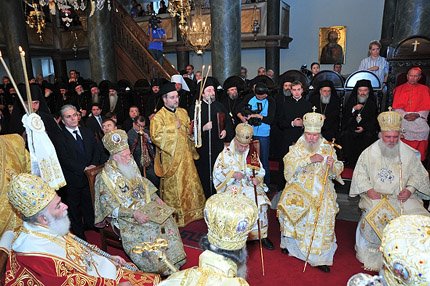
Patriarch Bartholomew, at far right seated, prays with Pope Benedict XVI, at far left, in the Sistine Chapel at the Vatican, Saturday Oct. 18, 2008

"Together with pope, ecumenical patriarch addresses synod for first time ever."

The patriarch of Constantinople, after speaking of the "historic event" because of his very presence at the synod, expressed his hope of arriving one day at "full unity" between Orthodox and Catholics, overcoming the current differences and agreeing "fully over the role of primacy and collegiality in the life of the Church." Bartholomew also indicated some concrete objectives: "as disciples of God," he added, "it is more imperative than ever to present a single perspective, beyond social, political, and economic views, on the need to uproot poverty, promote equilibrium in the globalized world, combat fundamentalism and racism, and develop religious tolerance in a world of conflict."

UPDATE: Full text of Patriarch Bartholomew's address to the Synod.

Friday, October 17, 2008

St. Ignatius of Antioch shows us the way to unity


Today is the feast day of St. Ignatius, bishop of Antioch, who was martyred in Rome in 107 AD under the Emperor Trajan. St. Ignatius shows us the way to unity by teaching us what the Catholic Church believed about ecclesial authority. It is what the same Catholic Church still believes and teaches today.

St. Ignatius, pray for us that all those who love our Lord Jesus will be united in full visible unity, for the glory and honor of our Lord Jesus, and for the salvation of the world.

Thursday, October 16, 2008

Let's give Him the gift He most deeply desires


"To love God is to wish Him all honour and glory and every good, and to endeavour, as far as we can, to obtain it for Him." (source)

"May they be brought to complete unity to let the world know that you sent me and have loved them even as you have loved me." (St. John 17:23)

Lord Jesus, may we by your grace, be granted to present to You this gift: the overcoming of our divisions. In the name of the Father, and of the Son, and of the Holy Spirit. Amen.

Wednesday, October 15, 2008

Unity, my way


In The Great Divorce, C.S. Lewis describes "grey town" as a place that is constantly expanding at its outskirts as people perpetually try to get farther away from each other, unable to get along with each other, and wanting to be lord of their own domain. That desire for autonomy continually divides and separates the citizens of 'grey town' from each other. I think it plays a similar role here on earth, even among Christians.

Responding to Catholic claims that we cannot have unity without a "uniform teaching authority", Michael Spencer writes:

I agree with your basic contention that we need the boundaries of unity and authority in order to talk about the "Christian faith." Millions of people reading their favorite verses to one another won't produce unity. If Protestantism has demonstrated anything, it's that.

But what kind of unity? Many of us believe that a kind of "creedal minimalism" brings the necessary unity to Christianity. The Nicene and Apostles' Creeds provide this minimum coverage, and the leadership of local churches (or geographic/denominational structures) use it for the purposes of mission, definition and discipline.

In other words, we don't believe that the infallible teaching authority of a completely hierarchical church defining every detail of Christian faith and mining tradition for further dogma is the necessary expression of unity. All the unity we need is available through the processes of a fallible church.


Earlier this year I presented some problems with the notion of a 'mere Christianity'. (Yes, here we have Lewis vs. Lewis.) If the "fallible church" to which Michael refers is the 'invisible Church', then how the invisible Church is supposed to provide the means for unity is never spelled out by anyone. Michael agrees that if Protestantism has demonstrated anything, it is that millions of people reading the Bible are not going to come to unity by doing so. But if Protestantism has demonstrated that, then hasn't it also demonstrated the failure of the "invisible Church" to unify Christians? Yet if by "fallible Church" Michael is referring to some set of embodied human persons, then what is it, exactly, that makes persons to be members of that set, and how does Michael know this, and who gets to determine the sufficient conditions for membership in this set, and why do they and not other people get to determine these conditions? There is no circumventing the authority problem, behind which lies the fundamental reason for our present disunity. We are either submitting to God-ordained authority, or submitting to a pseudo-authority whom we mistakenly think to be a God-ordained authority, or we are taking authority to ourselves, even in the very act of constructing the conditions upon which all Christians should be unified.

"But I hate him because he never prophesies anything good about me, but always bad." (1 Kings 22:8)

The fundamental problem with heresy is not the content of belief, but the basis of that belief. The content problem [i.e. having false beliefs] is derivative and per accidens. That's why persons born into heresies are not ipso facto guilty of heresy. Gnosticism misconstrues the fundamental problem with heresy as merely propositional. Hence the gnostic life consists in an unending series of theology readings aimed at honing one's orthodoxy (whether toward maximized specificity or specified minimization). But the beginning of wisdom is not a proposition per se; it is a disposition of the will toward God. (Psalm 111:10; Proverbs 9:10) If the devil were entirely orthodox in what he believed, but had come to believe these orthodox truths not through faith and trust in God, but through his own prideful efforts, would he be less estranged from God than he is now? With respect to the basis of the content of the faith, the 'mere Christianity' mentality is no different from any other form of Protestantism. The individual remains the final arbiter of what should be believed, and in this way the notion of a 'mere Christianity' remains intrinsically disposed to perpetual fragmentation. If the ecclesial authority says that more (or less) needs to be believed than we think needs to be believed, then we simply reject that authority, move farther out, and find authorities saying pretty much what we think, more or less, needs to be believed. Unity by 'mere Christianity' is still "unity, my way". But it is precisely the "my way" that is the root cause of disunity.

"For the time will come when they will not endure sound doctrine; but wanting to have their ears tickled, they will accumulate for themselves teachers in accordance to their own desires." (2 Timothy 4:3)

The resolution of the divisions between Christians does not consist in finding a lowest-common denominator or minimal content of Christianity around which we can all agree. That is because the fundamental source of the disunity between Christians is not the intellect; it is the will. Though lack of knowledge is a factor in perpetuating divison, lack of knowledge is not the ultimate source of our divisions. The fundamental cause of the disunity between the devil and God is the devil's will; it is his sin of pride. And likewise pride was the fundamental cause of the division between Adam and God. The antidote to our present disunity is the exact opposite of pride; it is humility. And this involves submitting to Christ by submitting to the shepherd He has placed over His flock (St. John 10:16). It has never ceased to be true that "He who listens to you listens to Me; he who rejects you rejects Me". (St. Luke 10:16) It wasn't some magical effect of having seen Christ that made this true of the Apostles; it was authorization to speak on behalf of Christ, the same authorization later given by the Apostles to their episcopal successors to speak on their behalf. Apart from submission to the authority had by apostolic succession, the only remaining option is the disunity of "millions of people reading their favorite verses to one another". We can either dip in the muddy Jordan seven times with Naaman and be healed, or we can go back to the rivers of Damascus and wash in a manner of our own choosing. The former is the only way to true unity. The latter is the multifarious way of sinful man, the way of perpetual division and ever-widening separation found in "grey town". Milton's Satan says "Better to reign in hell, than serve in heav'n", and this self-exalting disorientation of the will is intrinsically related to Sartre's "hell is other people"; it is precisely this that keeps extending the limits of 'grey town'.

"Beloved, let us love one another, for love is from God; and everyone who loves is born of God and knows God." (1 John 4:7)

By contrast, love turns us back around, toward unity, away from pride, away from self-exaltation, and away from division. Love does not sacrifice truth; it labors to share truth with one's neighbor, and listens to receive truth from one's neighbor, in order to be truly one with one's neighbor. That's why love is catholic, and not provincial or sectarian; love seeks to evangelize the whole world, and it listens humbly to the whole world. Love is the perfection of truth, the adequatio of person to person. And humility is bound up in love, as demonstrated in Christ's humbling of Himself in love. Love therefore is what brings us back from the outskirts of grey town, to our knees in humility before Christ and His Body, so that we may be incorporated into this one Body, with one faith, having the same Spirit, and under one hierarchy. Love draws us to dance together.

The Wedding Dance
Marten Van Cleve (1527-1581)

Tuesday, October 14, 2008

Orthodox Leaders Join in Pledge for Unity


Heads of the Orthodox Churches
Photo by D. Panagos (Oct. 12, 2008)

The Primates of the Orthodox Churches, meeting over the last three days in the Patriarchal Cathedral of Saint George in Istanbul, Turkey, have just released a document titled "Message of the Primates of the Orthodox Churches".

Here's one section:

"The Orthodox Church, having the understanding of the authentic interpretation of the teaching of the Apostle to the Nations, in both peaceful and difficult times of its two-thousand year historical course, can and must promote to the contemporary world the teaching not only regarding the restoration in Christ of the unity of the entire human race, but also regarding the universality of His work of redemption, through which all the divisions of the world are overcome and the common nature of all human beings is affirmed. Nevertheless, the faithful promotion of this message of redemption also presupposes overcoming the internal conflicts of the Orthodox Church through the surrendering of nationalistic, ethnic and ideological extremes of the past. For only in this way will the word of Orthodoxy have a necessary impact on the contemporary world." (my emphases)

Amen. There is one phrase later in the document that made my ears perk up:

"In this respect we welcome the proposal by the Ecumenical Patriarchate to convene Panorthodox Consultations within the coming year 2009 on this subject, as well as for the continuation of preparations for the Holy and Great Council.

There has been talk among the Orthodox for some time about an "Eighth Ecumenical Council". Pray that this "Holy and Great Council" would be an Ecumenical Council, including West and East together. Wouldn't that be a beautiful and fitting resolution to this 954 year-old schism?

"Μόνον πίστευε"! [Only believe!] (Mark 5:36)

(H/T: Catholic Culture)