But another reason for my relative silence has been that I have focused on completing and defending my dissertation, which I did in December of 2012. I have since taken up a position at Mount Mercy University in Cedar Rapids, Iowa; my office is in the building pictured in the photo to the right. So now I am focusing my energy and time on serving my students here at MMU. I believe that education in its fullest sense is a personal activity, and for humans that means that it is an embodied activity. Education is like eating together; you can't do that as well, or truly, while separated some great spatial distance. Philosophical education, in its fullest form, includes sapiential formation. And that takes place most perfectly only in shared embodied life together. Does that mean that there is no place for online or internet discussions/education? No, of course not. But for me it does mean that the form of education to which I wish to devote most of my energy and time is embodied education in embodied community, in face to face discussions, over shared meals, in reading groups conducted not just in classrooms or cafeteria, but also in my home, and in concrete charitable work done in the flesh together with others in the flesh. Lost in the ether of the internet is the dimension of the gospel that is incarnate, not gnostic. So I will not be posting here much at all for the foreseeable future. However, if any readers wish to study with me in this embodied, human way, here at Mount Mercy University, please contact me.
Saturday, December 14, 2013
A Brief Update
But another reason for my relative silence has been that I have focused on completing and defending my dissertation, which I did in December of 2012. I have since taken up a position at Mount Mercy University in Cedar Rapids, Iowa; my office is in the building pictured in the photo to the right. So now I am focusing my energy and time on serving my students here at MMU. I believe that education in its fullest sense is a personal activity, and for humans that means that it is an embodied activity. Education is like eating together; you can't do that as well, or truly, while separated some great spatial distance. Philosophical education, in its fullest form, includes sapiential formation. And that takes place most perfectly only in shared embodied life together. Does that mean that there is no place for online or internet discussions/education? No, of course not. But for me it does mean that the form of education to which I wish to devote most of my energy and time is embodied education in embodied community, in face to face discussions, over shared meals, in reading groups conducted not just in classrooms or cafeteria, but also in my home, and in concrete charitable work done in the flesh together with others in the flesh. Lost in the ether of the internet is the dimension of the gospel that is incarnate, not gnostic. So I will not be posting here much at all for the foreseeable future. However, if any readers wish to study with me in this embodied, human way, here at Mount Mercy University, please contact me.
Wednesday, March 20, 2013
Sunday, September 23, 2012
"I Fought the Church, and the Church Won"
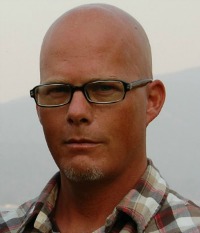
Jason Stellman served as a missionary with Calvary Chapel of Costa Mesa in Uganda (’91-’92) and in Hungary (’94-’00). After becoming Reformed he went to Westminster Seminary California where he received an M.Div. in 2004. Upon graduation he was ordained by the Pacific Northwest Presbytery of the Presbyterian Church in America and called to plant Exile Presbyterian Church in the Seattle area, where he served from 2004 until resigning in the Spring of 2012. He is the author of Dual Citizens: Worship and Life Between the Already and the Not Yet (Reformation Trust, 2009), and The Destiny of the Species (forthcoming from Wipf and Stock Publications). In 2011 he served as the prosecutor in the heresy trial of Peter Leithart in the Pacific Northwest Presbytery of the PCA. He currently resides in the Seattle area with his wife and three children. He was received into full communion with the Catholic Church today, September 23, 2012. In the following article he explains how and why he went from Reformed pastor to Catholic. Continue reading
Monday, May 28, 2012
Joshua Lim's Story: A Westminster Seminary California Student becomes Catholic
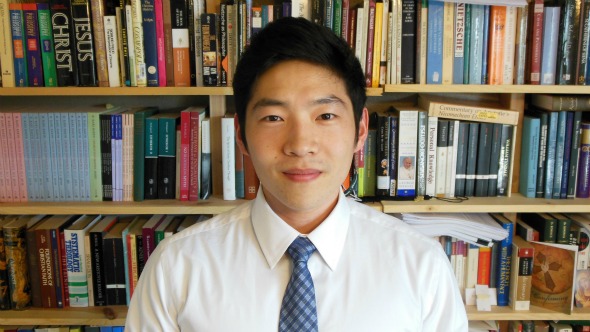
Joshua Lim graduated this Spring from Westminster Seminary California, where he earned his MA in historical theology. He was born and raised in the PCUSA. He spent a few years in college as a Baptist before moving back to a confessional Reformed denomination (URCNA) prior to entering seminary. He was received into full communion with the Catholic Church this year on April 21st, the feast day of St. Anselm. In this CTC article, he explains how he came to be Catholic during his final year at a Presbyterian seminary.
Continue readingFriday, May 25, 2012
“Too catholic to be Catholic?” A Response to Peter Leithart
Peter Leithart, a fellow at New St. Andrews College, pastor of Trinity Reformed Church in Moscow, Idaho, and contributor to journals such as First Things and Touchstone recently posted an article titled "Too catholic to be Catholic." The article has been widely shared and discussed, provoking both approval and criticism from different groups of persons. Leithart followed up his article with a response to one common criticism; his response is titled "Israel, Idolatry, and Separated Brothers." A good evaluation of Leithart's argument, from a Catholic point of view, can be found here: "“Too catholic to be Catholic?” A Response to Peter Leithart."
Tuesday, May 22, 2012
An Opportunity to help Catholic Education
There are very few more prudent cultural investments than excellent primary education. See John Senior's books The Death of Christian Culture, and The Restoration of Christian Culture. See also Pope Pius XI's "Divini Illius Magistri," and his "Rappresentanti in terra, both on the subject of Christian education. I learned this week that a traditional Catholic K-12 school, John Paul the Great Academy in Lafayette, Louisiana, is facing a dire financial crisis, and could be forced to close. If you would like to help out the school, please visit their website and click on the "Support JPG" tab.
Tuesday, February 14, 2012
Making My Way to the Church Christ Founded
Fred Noltie was in the Presbyterian Church in America (PCA) for twenty years, attending both Covenant College and Westminster Theological Seminary in Philadelphia. On the Easter Vigil of 2005 he, his wife Sabryna, and their son were together received into full communion with the Catholic Church at St. Lawrence parish in Monett, Missouri, where they are presently members. In this article Fred tells the story how he and his family became Catholic. He writes:
In The Accidental Catholic I described how I realized that Protestantism’s proposed means for discerning revealed truth in the Bible do not afford us any basis for certainty about what that truth actually is. This fact, which struck me like a bolt out of the blue, forced me to realize that I could not remain a Protestant. But on the day that I decided that I was no longer Protestant I was equally certain that I would never become Catholic. I was just not interested in that at all, because – after all – it was the Catholic Church, and I just "knew" it was wrong! Why did I change my mind?
Continue reading
Tuesday, February 7, 2012
An OPC Pastor Enters the Catholic Church
Jason Stewart was an ordained minister in the Orthodox Presbyterian Church (OPC), having earned his Master of Divinity from Mid-America Reformed Seminary (Dyer, IN) in 2005, and subsequently served for 5 1/2 years as pastor of Trinity OPC in eastern Pennsylvania. He and his wife Cindy were received into full communion with the Catholic Church on January 10, 2011 at St. Jane de Chantal Catholic Church in Easton, PA. Many people have asked Jason why he became Catholic. Here, in the following article, he explains why he became Catholic. He writes:
"I hope to tell my story simply, because it is genuinely uncomplicated. Complex, yes. Multi-layered, sure. Who's journey in the Christian faith isn't? But I do promise to keep the telling of it simple by concentrating on the main catalysts that gave my wife Cindy and me the courage to approach the doors of the Catholic Church and with confidence begin to knock...."
(Continue reading)
Monday, January 30, 2012
A Response to Scott Clark and Robert Godfrey's “The Lure of Rome”
In November of last year, Scott Clark and Robert Godfrey, both professors at Westminster Seminary in California, made a podcast titled "The Lure of Rome," in which they attempted both to explain why so many Evangelicals and even Calvinists are becoming Catholic, and why such persons are mistaken in doing so. Andrew Preslar has written a helpful response to Clark and Godfrey, in which he takes up the issue of the development of doctrine, because in their argument against becoming Catholic, Clark and Godfrey presuppose the denial of the development of doctrine.
Andrew's article is titled "A Response to Scott Clark and Robert Godfrey on "The Lure of Rome"."
Sunday, October 30, 2011
Reformation Sunday 2011: How Would Protestants Know When to Return?
Imagine that the Occupy Wall Street protest continued for years, during which time the community of protesters divided into different factions, each with different beliefs, different demands, and different leaders. But the protests continued for so long that the protesters eventually built makeshift shanties and lived in them, and had children. These children grew up in the protesting communities, and then they too had children, who also grew up in the same communities of protesters, still encamped in the Wall Street district. Over the course of these generations, however, these communities of protesters forgot what it was that they were protesting. They even forgot that they were protesting. Life in the shanties in Wall Street was what these subsequent generations had always known. They did not even know that they had inherited a protesting way of life, separated from the rest of society. When asked by a reporter what Wall Street would have to change in order to get them to return home, they looked at him confusedly, and responded, "We are home; this is home." They no longer had any intention to 'return to society' upon achieving some political or economic reform. For them, camping out on Wall Street was life as normal, and those with whom they had grown up camping simply were their society. Continue reading
Wednesday, October 26, 2011
Into the Half-Way House: The Story of an Episcopal Priest
At Yale, there used to be an auxiliary library buried underneath the green in front the Sterling Memorial Library. One fine fall day, I happened to find myself not out amongst the foliage but rather tucked away below the sunshine and the sod, reading a book. I suppose it was an odd choice. This was the ugliest space I know of on an otherwise beautiful campus. So ugly, in fact, that it was targeted for a remodel and is now gone. But there I was, and perhaps even more odd, I, a good Anglican-priest-in-training, was reading Cardinal Newman. Not the good parts that we Anglicans agreed with; the parts about the Oxford movement and the Church Fathers. No, I was reading the Apologia; the story of his conversion to the Catholic Church. I was particularly bothered by one specific bit. Continue reading
Sunday, August 21, 2011
Philosophy and the Papacy
The Scripture readings for today's liturgy provide a biblical basis for the papacy, as John Bergsma explains. But as a Protestant, I was not able to see those verses as providing that basis, until I read Plato's Republic. Of the various philosophical factors that helped me become Catholic, one was teaching through Plato's Republic. I had taught it a few times before, but this time, I was teaching it with an eye toward its implications regarding unity. My conclusion was that for philosophical reasons we could expect Christ to have established for the Church an enduring office for her government, an office occupied by one person at a time. That conclusion allowed me to be more open and receptive to the Catholic understanding of Matthew 16:18-19, Luke 22:32, and John 21:15-17. So how did Plato's Republic help me reach that conclusion?
In order to explain the role of Plato's Republic in helping me become more open to the Catholic understanding of St. Peter's unique office in the Church, I need to lay out the broader line of reasoning to which it contributed. That line of reasoning was as follows.
(Continue reading)
Monday, August 15, 2011
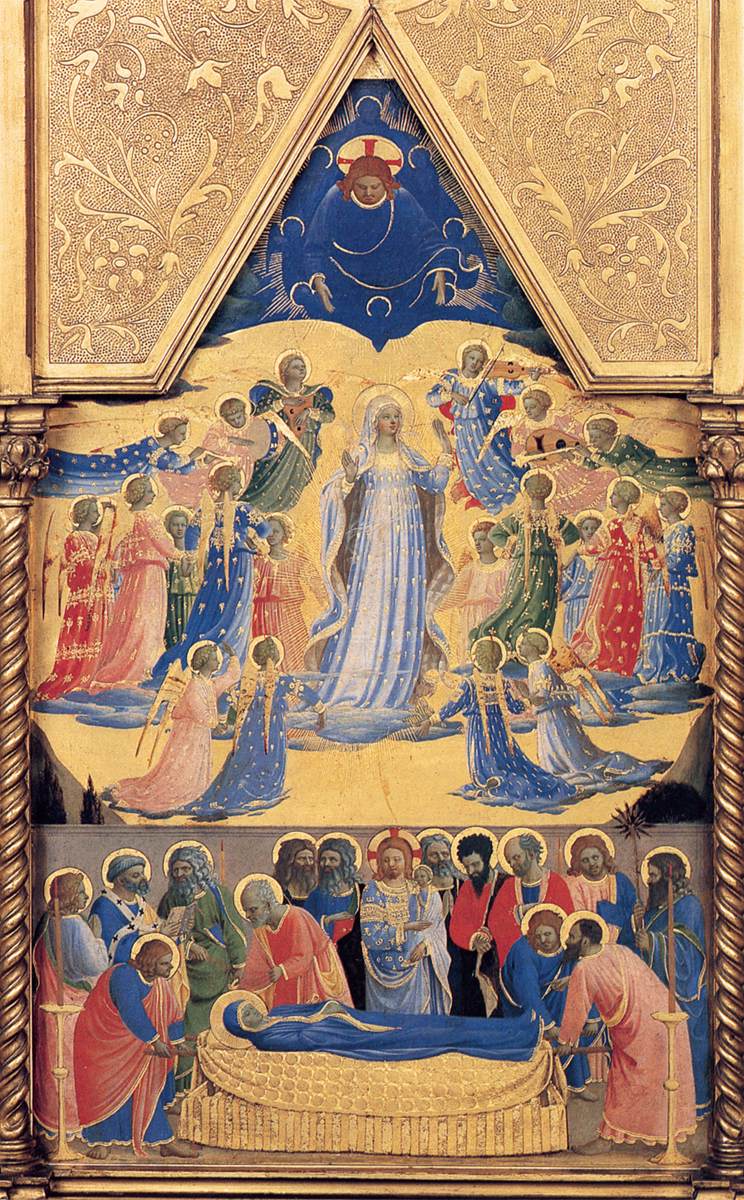
Solemnity of the Assumption of the Virgin Mary
Today, August 15, is the Solemnity of the Assumption of the Virgin Mary into Heaven. On this day, the universal Church celebrates what took place at the end of our Blessed Mother’s earthly life. “The Immaculate Mother of God, the ever Virgin Mary, having completed the course of her earthly life, was assumed body and soul into heavenly glory.” This dogma is the great antidote to materialism and the moral corruption that follows despair, because in Mary’s Assumption into heaven we see our own glorious destiny as fellow creatures like her, united to her Son. In her Assumption we see the eschatological finale awaiting the Church, of which she is the icon.
This doctrine was not formally defined as a dogma until 1950, when Pope Pius XII did so in an Apostolic Constitution titled Munificentissimus Deus. Although the Orthodox have not formally defined the doctrine as a dogma, this doctrine is not a point of dispute between Catholics and Orthodox, because the Feast of the Assumption has been celebrated in the universal Church (both East and West) on this same date (August 15) since the sixth and seventh centuries. However, this doctrine is not accepted by most Protestants, and is therefore an occasion of difficulty with respect to the reconciliation of Protestants and the Catholic Church.
Recently Peter Leithart responded to Christian Smith's claim that sola Scriptura is the belief that Christians have "the Bible alone and no other human tradition as authority." Leithart protested against this definition, claiming that the Reformed do acknowledge the authority of tradition, but hold Scripture to have final authority. My response to Leithart can be found here, where I argue (briefly) that to subject tradition to the test of one's own interpretation of Scripture is to deny the authority of tradition, and thus to vindicate Smith's claim. ...
(Continue reading)
Monday, August 8, 2011
A Reflection on PCA Pastor Terry Johnson’s “Our Collapsing Ecclesiology”
Terry Johnson, senior minister of Independent Presbyterian Church (PCA) in Savannah, Ga., wrote an article titled "Our Collapsing Ecclesiology" in the March issue of the Orthodox Presbyterian Church's magazine New Horizons. The article is well worth reading, because it examines the recent trends in Evangelicalism away from attendance in Sunday morning services, even away from organized institutional church altogether. It cites George Barna's announcement of the "New Church," which is "without structure, organization, clergy, officers, accountability, or discipline. It has no location, commitments, or physical presence. It is merely an informal, ad hoc, uncovenanted association of believers." According to this view "the local church ceases to exist. The requirement of Hebrews 10:25 (that believers assemble together) could be fulfilled ... "in a worship service or at Starbucks." In the mind of these Evangelicals, "I am not called to attend or join a church. I am called to be the church." For them, writes Terry, "Church ... is like the YMCA, except that one actually has to join the YMCA. It's good to go there to exercise, but sometimes one can do just as well at home—or maybe somewhere else. "Do what feels right for you," we hear said. "Go where your needs are met."
Continue reading
Wednesday, June 1, 2011
St. Vincent of Lérins and St. Optatus of Milevis
May 24 was the feast day of St. Vincent of Lérins, a soldier who became a monk at the monastery in Lérins, and wrote his famous Commonitory in AD 434, three years after the third Ecumenical Council at Ephesus, and seventeen years before the Ecumenical Council of Chalcedon. He wrote to explain the rule he had received, by which the truth of the Catholic faith can be distinguished from the falsehood of heresy. June 4 is the feast of St. Optatus, a fourth-century bishop of Milevis, about ten miles from the Mediterranean Sea on the coast of northern Africa in what is now Algeria. He was a convert to the Catholic faith, and an African by birth. His major work is titled Against the Donatists, written between AD 372 and 375. How are the writings of these two saints related to the ecumenical effort to bring all Christ's followers into full and visible unity? See "The Commonitory of St. Vincent of Lérins" and "St. Optatus on Schism and the Bishop of Rome."
Wednesday, May 11, 2011
Imputation and Infusion: A Reply to R.C. Sproul Jr.
Sproul appeals to the Pharisee's use of "Lord, I thank you" as evidence that the Pharisee knows that he needs the grace of God, that the power to make him righteous came from God, and that God deserves all the glory for his obedience to God. The Publican too, notes Sproul, knows that he needs grace from God. Thus, according to Sproul, the difference between the Pharisee and the Publican does not lie in their awareness of the divine origin of grace and righteousness. They both know that grace and righteousness come from God.
According to Sproul, the difference between the Pharisee and the Publican is this: the Pharisee believes that God’s grace has “made him whole” while the Publican knows that he is an unrighteous sinner. Because of this difference, claims Sproul, the Publican will spend eternity walking with God, while the Pharisee will spend eternity weeping and gnashing his teeth. But here’s the kicker: (continue reading)
Thursday, May 5, 2011
Rome's non-enemy seeks full communion with her
I first 'met' Bill Chellis through his blog De Regno Christi back in September of 2007. He was the pastor of Rochester Reformed Presbyterian Church in Rochester, New York, which is a member of the Reformed Presbyterian Church of North America. During the last two weeks of September of 2007, Bill hosted a two week discussion/debate between proponents and opponents of the theological position known as the Federal Vision, on De Regno Christi. I followed the discussion carefully, and commented there occasionally. The discussion prompted my post here titled "Darryl Hart on the Need for Sacramental Magisterial Authority," and a few days later "Protestantism "left only with opinions".
Two years later, in October of 2009, Bill published a post titled "Why Rome is not my enemy," which I wrote about in "William Chellis: Why Rome is not my enemy."
Then a few weeks ago Bill started a new blog named The Augustinian Anglo-Papist, on which, in a post titled "From Geneva to Rome," he announced that he is now seeking full communion with the Catholic Church. He writes:
This is a pilgrim's blog. It is the story of a journey in progress. I once took my stand with the militant Presbyterians. I served as a Pastor of small confessional, orthodox Presbyterian congregation in a small conservative and strident denomination. The Reformed Presbyterian Church was my home.
More than my home, she was my mother. She gave me life by pointing me to the riches of Christ. She fed and nourished my spiritual life on a steady diet of Word, sacrament and prayer. I will always love and honor her, as I will always love an honor my friends in Christ who remain within her.
If I am a catholic today, it is because she taught me to love the catholic faith. If she is not able to recognize the catholic faith in Rome, then I will lovingly disagree and pray for the unity of Christendom!
For, over time, my mind has changed. My search for the catholic faith has lead me to an unexpected place. Convinced that our Puritanism was another century's liberalism, my family began worshipping among the Anglicans. A fan of C.S. Lewis and T.S. Eliot, Anglicanism was an easy friend. The beauty of Anglo-Catholic liturgy and devotion, the wholesome goodness of the Book of Common Prayer, the Sermons of John Henry Newman were sources of great blessing. I even began to consider incardination into Anglican Holy Orders.
The more I prayed, however, the more restless I became. Anglicanism was an easy fit but was it the right fit? Could I really keep one foot in Geneva while having the other in Rome? Would I not be spewed out for being lukewarm?
After much prayer, sweat, blood, tears my Puritanism has transformed into Popery. From Geneva to Canterbury to Rome, this was my path. ... (continue reading)
Please pray for Bill and his family as they make this transition, and welcome them warmly into full communion with the Catholic Church.
Friday, February 25, 2011
Michael Liccione and Neal Judisch Reply to Keith Mathison
Michael Liccione and Neal Judisch have both written replies to Keith Mathison's Reply.
Michael's article is titled "Mathison’s Reply to Cross and Judisch: A Largely Philosophical Critique." In it he focuses on what he claims is the most important philosophical issue in the debate, namely, that the disagreement is paradigmatic, that is, that the differences between the Protestant and Catholic positions are not intra-paradigmatic, but involve two distinct paradigms that must be understood as distinct paradigms to be understood rightly and to be compared properly. In other words, resolving the disagreement requires comparing the paradigms, and thus comparing the framework that constitutes the respective paradigms. Michael examines and compares the interpretive paradigms operative between Catholicism and Protestantism, and explains how those paradigms can be evaluated against each other.
Neal's article is titled, "Some Preliminary Reflections on Mathison’s Dialectic." In it he offers a critical evaluation of Keith's claim that the principled distinction between Solo Scriptura and Sola Scriptura is visible to the inquirer only if the inquirer presupposes Catholic ecclesiology. Neal argues that Keith's claim is not plausible, and that it does not address the argument we raised in our 2009 article "Solo Scriptura, Sola Scriptura, and the Question of Interpretive Authority." He writes:
[T]he “Catholic presupposition-induced blindness” to the distinction Mathison draws is a putative psychological-cum-epistemological fact about Catholics. But the allegation that our case for the No Distinction Thesis is “circular and question-begging” is a putative fact about the logic of the argument. And there is a principled distinction between these things, which Mathison has perhaps not seen. For arguments (like offspring) need not inherit their parents’ defects; a fortiori when the defects are of categorically different kinds.
Once an argument marches forth into the wider world, the umbilical cord is severed and it takes on a life very much its own – to be praised or to be blamed in accord with its merits. And no amount of blaming its authors for blindness can imply that an argument they gave is guilty of circularity. For it is at any rate possible that Bryan and I in Athenian fashion groped hazily about, read incautiously and uncharitably, or embraced the No Distinction Thesis merely via some quasi-Freudian wish-fulfillment mechanism; but, like the proverbial blind hog, we might for all that have delivered into the world an acorn without so much as knowing how we’d done it.
(continue reading Neal's article)
Wednesday, February 16, 2011
Keith Mathison's Reply
In November of 2009, Neal Judisch and I posted an article titled "Solo Scriptura, Sola Scriptura, and the Question of Interpretive Authority." The article provoked a good deal of discussion, the comments now number over 1,200. Our article was a reply to Keith Mathison's book The Shape of Sola Scripura, and focused on the distinction Keith makes between sola scriptura and what he calls "solo scriptura."
In his book Keith argued strongly against solo scriptura, and endorsed sola scriptura as the rightful alternative. In our article, we argued that there is no essential difference between solo scriptura and sola scriptura. The defining feature of solo scriptura is the retention by each individual of ultimate interpretive authority, but under sola scriptura, each individual likewise retains ultimate interpretive authority, even if that fact is somewhat hidden by forming associations of those sharing similar interpretations of Scripture and appointing officers among such associations.
Last year Keith assured us that he would write a reply. Yesterday, he announced that he has completed his reply. It can be read at the following link: "Solo Scriptura, Sola Scriptura, and Apostolic Succession: A Response to Bryan Cross and Neal Judisch." A pdf version of his reply is available here. I expect that in the coming weeks we will write a reply to Keith's reply; in the mean time, follow the discussion of Keith's reply here.